Curious Christian

Exploring life, art, spirituality, and the way of Jesus

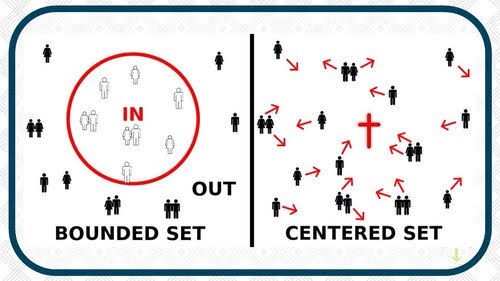
The problem with a bounded-set approach to Christianity is not that it highlights the difference between Christians and non-Christians; it’s that it highlights the wrong differences, and encourages us to exaggerate and claim differences that don’t exist. For instance, Jesus had a lot to say about concern for the poor. But if we think that non-Christians are also concerned for the poor, we won’t focus on it much because it doesn’t highlight “how we are different.” – John Ortberg

Great quote don’t you think? If instead we focus on Jesus, centered-set style, then the key question becomes whether someone is oriented toward Jesus or away from him. We realize that God is in a much better position than we are to know who’s in and who’s out. We also realize that everyone has something to learn, that everyone has a next step to take, and we don’t have to make ourselves seem more different than we really are. It puts us in a better position to affirm our convictions constructively, irrespective of who agrees or disagrees with us.

5 responses to “Baulking at Bounded Set-Christianity”

  1. Phil Wood Avatar

    It also makes belonging less like negotiating a set of a arbitrary hurdles. I sometimes wonder whether Christians spend hours of gleeful fun designing the most perverse boundary markers.

    Like

  2. Kalessin Avatar
    Kalessin

    HouRS? I’ll have you know this stuff takes CeNtuRiEs…

    Like

  3. Lucy J Avatar
    Lucy J

    … failing that, we can make them up as we go!
    But seriously, something I read in a Brian McLaren book several years ago has really stuck with me and I have sometimes workshopped the concept in creative movement workshops is a suggestion of four ways of thinking about people’s (the church’s?) concept of inclusiveness. This was illustrated by diagrammes
    1. Boundary thinking: a circle with some dots randomly inside and outside of the perimeter – you can see who is “in” and who is “out”
    2. Centered thinking: the circle has the a dot in the middle representing Jesus and the other random dots in the same places so you can now see who is closer to Jesus and who isn’t (maybe if you’re in the circle, you may not be particularly close to where he’s at)
    3. Progress thinking (I think it was called that): the circle boundary is removed but the dots stay in the same configuration but each has a little direction arrow indicating movement, so if the dot/person moved along, they may not be on a pathway to the centre Jesus dot (a person may be “in”, but their pathway is ultimately on a different pathway to actually connecting with Jesus)
    4. Journey thinking (my personal favourite): the Jesus dot is given a direction arrow, so that now if you projected the pathways of the other people/dots, it’s a different outcome as to who is moving in the same direction as Jesus.
    I like the last point because it opens possibilities. It takes the static nature out of the relationships amongst the people and touches on the dynamics of relationship with a Lord who IS THE WAY, who is not static, but living and moving… going somewhere with a purpose.
    Of course diagrammes/diagrams and analogies have limitations, but they can express something valuable, so and I have found the above points (apologies if my verbal description is inadequate), helpful when I think in terms of differences of approach and outworking that Christ-followers and people who do not follow Christ, encounter when they interact in various contexts.
    An example springs to mind since Matt mentioned “the poor”: some Christians help the poor out of dry duty or because they are compulsed to feel “needed”, but a Christ-follower, closer to the person of Jesus in relationship (more matured in The Way), would have healthier reasons for blessing the poor. Although they may get a good feeling of satisfaction or joy at having participated in Jesus’ works of mercy and transformation, it wasn’t a craving for that, or a salve for a troubled conscience that motivated them to do it. They followed Jesus teachings, but also “met Him” on The Way. Perhaps sometimes a person who is not a Christ-follower may help the poor for healthier reasons. They may be walking a life path that is “better” but which has not intersected with Jesus as The Way.
    I think the world would be a better place if people were more humble and gracious when they encountered “differences” amongst those whom they considered “in their circle” of faith or those considered outside of it.

    Like

  4. Matt Stone Avatar

    You’ve got me mulling over 3 and 4 Lucy. I like the journey metaphor, but at the same time there are things about Jesus that don’t change, so I’m thinking it partly depends on context as to which I’d prefer. Prefer either over 1 or 2 though.

    Like

  5. Kalessin Avatar
    Kalessin

    I recently had to write a constitution for a new church, and discovered that if you want congregational government, you have to have a bounded set in some regard. Can another group come in, claim to be members and then vote on property issues without meeting some standard, for example? We settled on the four-tiered model of a community that we serve, containing an invisible church, containing a visible church, containing an elected board of elders providing leadership. This seemed to allow a centered set (or progress or journey model, a la Lucy) at a social level — no requirements for belonging to the community; no necessary link between being a Christian and being a member of this specific church — but a bounded set for the visible church. Local membership means taking responsibility for the local community. It’s looking like making sense thus far.

    Like

Leave a comment