I have been reflecting on Deuteronomy 7 today, which is a passage I always find more difficult. The language of devoting whole populations to destruction—men, women, and children—sits uneasily with me, especially when I am trying to hold onto a vision of God revealed most clearly in Jesus.
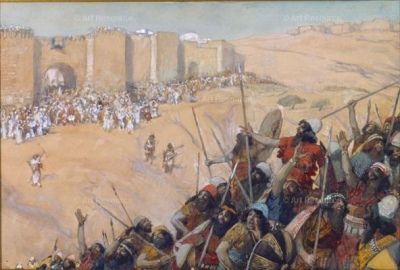
However, rather than rushing to resolve the tension, I tried to sit more carefully with the text itself, particularly with how it might have been heard by its original audience.
One thing that stood out afresh is that the command is not framed as a blanket instruction toward all peoples everywhere. Deuteronomy 7 focuses on seven specific nations that God gives into Israel’s hand. It is a particular, geographically and temporally bound act within a covenantal situation.
Later texts, such as Deuteronomy 20 and the conquest narratives in Joshua, make explicit that God’s commands often targeted fortified cities rather than the countryside. Most of the population lived outside these cities, in villages, farms, and rural settlements, so the commands were strategic and limited, directed at the centers of idolatry and organized resistance, not indiscriminate annihilation of all people in the land.
Later, my fiancée reminded me of Deuteronomy 1, where Israel is commanded to treat the foreigner with justice and fairness. That sequencing matters. It makes clear that the default posture of Israel toward outsiders is one of care and impartiality. In that light, Deuteronomy 7 appears less like a universal principle and more like a narrow, exceptional moment where God exercises judgment against entrenched idolatry and covenantal threats.
That insight pushed me toward a reading that feels both honest and grounded. Ancient Israel likely understood God to command this action in that context, but neither the text nor the broader Torah teaches that it is a standing instruction for all generations. This resonates strongly with rabbinical interpretation, which treats these commands as historically situated rather than eternally prescriptive, emphasizing context and covenant fidelity rather than universal moral mandates.
Only after that historical work did I make the Christocentric move, and I think it matters that it comes second. For Christians, the revelation of God in Jesus reframes these texts: “Do not take revenge, my dear friends, but leave room for God’s wrath” (Romans 12:19). Judgment belongs to God, not to us.
The peoples and fortified cities of old become, for us, symbols of entrenched sin, both personal and systemic. The call for Christians is not to destroy, but to be vigilant against what corrupts and dehumanizes, while trusting in God’s ultimate justice.
Where I’ve landed is this: Deuteronomy 7 is a difficult but honest witness to how Israel understood God in a particular moment. It is limited in scope, geographically and temporally. Read through Christ, it is transformed. And perhaps part of its enduring value is precisely that it refuses to let us take either God’s justice or our own moral discomfort lightly.





 Curious Christian
Leave a comment