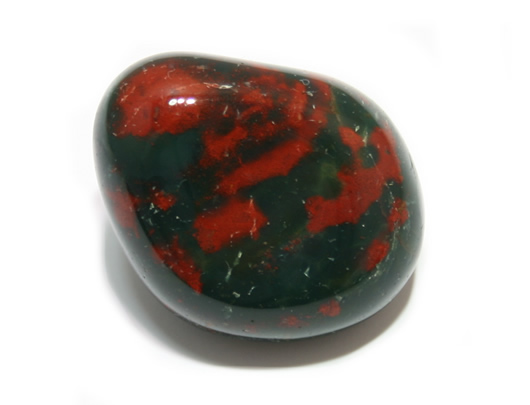
Many years ago at the Mind Body Spirit Festival in Sydney I devised a series of Christian meditative exercises based on healing gemstones and crystals. I have never really put any of this into print before so I thought maybe it was about time I published a few teasers. It is probably worthy of a full blown article to explain it all properly but since it wont be long till the kids wake up, well, maybe I’ll just introduce you to just one of the gemstones I have found useful: the bloodstone.
In Bloodstone: the Martyr’s Gem one author writes:
Bloodstone, green jasper dotted with bright red spots of iron oxide, was treasured in ancient times and long served as the birthstone for March. This attractive chalcedony quartz is also known as Heliotrope because in ancient times polished stones were described as reflecting the sun: perhaps the appearance of the gem reminded the ancients of the red setting sun reflected in the ocean.
Medieval Christians often used bloodstone to carve scenes of the crucifixion and martyrs, leading it to also be dubbed martyr’s stone. The legend of the origin of bloodstone says that it was first formed when some drops of Christ’s blood fell and stained some jasper at the foot of the cross. A beautiful example of carved bloodstone with the seal of the German Emperor Rudolf II can be seen at the Louvre museum in Paris.
Even today, finely powdered bloodstone is used as a medicine and aphrodisiac in India. Perhaps that explains why today it is difficult to find fine specimens of bloodstone on the market. Bloodstone is mined in India, Australia, and the United States.
Perhaps you can see where I’m going with this. For those that like tactile worship experiences, the bloodstone can be an excellent focus point for reflecting on the sacrifice of Christ Jesus. Consider that the ancient Israelites use to incorporate gemstones into the priests garments to symbolically evoke sacred truths. As with icons, we must be careful that we don’t cross the line into idolatry, but with those cautions in mind, consider: why did the creator create such objects of beauty?


 Curious Christian
Leave a comment