It is unfortunate that, when Christian leaders discuss peacemaking versus war making at all, they often limit the discussion to comparing Just War doctrine with an ill defined Pacifism as if it were a simple choise between these two options. This is too simplistic by far. Consider these six alternatives for instance:
Total War – War in which the contenders mobilize all of their civilian and military resources in order to obtain a complete victory. It is a very pragmatic approach in which the ends (national victory) justifies the means (nukes, collateral damage, torture, whatever) and the ends are never seriously theologically or ethically questioned. Loyality is everything, surrender is unthinkable.
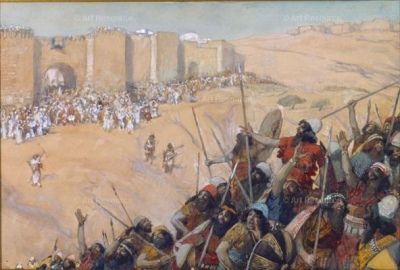
Holy War – War that is declared or fought for a religious or high moral purpose, as to extend or defend a religion. For example, a “crusade” or “jihad”. In this context surrender is considered, not only treasonous, but heretical. Holy wars may be executed in pragmatic or less pragmatic liturgical fashion but either way they are generally initiated by a religious leader, such as a prophet or pope. This is a type of war often featured in the Old Testament, but not always.
Just War – War that is declared and fought within ethically proscribed limits. For example it is commonly said there must be just cause, competent authority, comparative justice, right intention, last resort, proportionality and probability for success for a war to be called just. Taken seriously it implies that, in war, there are things worse than surrender. Just war doctrine originates from Cicero and entered Christian tradition via Augustine and Aquinas. One implication of just war doctrine is selective conscientious objection.
Apocalyptic Pacifism – Warmaking can never lead to the Kingdom of God. Whatever God commanded in Old Testament days, it is clear that God’s command in these last days is to follow Christ in the way of the cross. Disciples should not take revenge but leave room for God’s judgment, since God alone is just. Our focus, in light of the life, crucifixion and resurrection of Jesus, should be on active peacemaking and nonviolent witness. This view emphasises the difference between old and new covenants as a movement towards climax.
Universalist Pacifism – War is never justified and has never been justified. God is no warrior and this is a timeless truth. This view stands in significant tension with the wars of YHWH in the Old Testament, often necessitating a rejection of inerrancy by the Christians who hold it. Debates over the meaning of the Old Testament commandment, “Thou shalt not kill”, are most common in relation to this tradition. Many of the “spiritual but not religious” gravitate towards this position as well.
Isolationist Pacifism – A rejection of war that involves “passive withdrawal” rather than “nonviolent activism”. For example, the exemption from military service granted to priests and monks who do not otherwise challenge the Christendom status quo. It’s this approach that most often leads to the confusion of pacifism with passivity.
Contrary to popular belief, my experience is that most Christians would be more accurately identified as Total War Christians and that Just War Christianity, properly understood, is almost as uncommon as pacifism. But even within pacifist circles there are a variety of approaches, showing the folly of speaking of pacifism generically. For the record, I seek to live a life consistent with Apocalyptic Pacifism, as that’s the path I find most consistent with scripture. I’m not sure where you see yourself or how you interpret scripture but I hope this stimulates your thinking.







 Curious Christian
Leave a comment