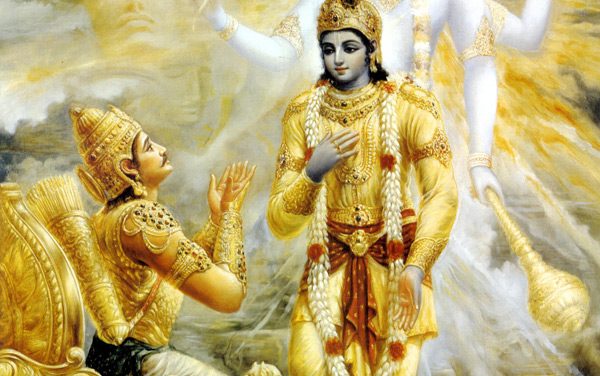
The Bhagavad Gita is a small book set inside a very large story — the epic of the Mahabharata. It opens not in a temple or monastery, but on a battlefield. Arjuna, a warrior, is paralysed by moral anguish at the thought of fighting his own kin. In response, Krishna reveals profound teachings about duty (dharma), devotion (bhakti yoga), knowledge (jnana yoga), and disciplined action (karma yoga).
As a Christian, I cannot read it neutrally. But I also cannot read it dismissively.
A Sacred Dialogue in a Time of Crisis
One of the most striking parallels with the Bible is the setting of crisis. Like Arjuna, many biblical figures encounter God at moments of inner and outer conflict. Think of Job’s suffering, Isaiah’s vision in the temple, or Jesus in Gethsemane.
Yet there is an important difference. In the Gita, Krishna ultimately calls Arjuna to fulfil his warrior duty. He must fight. The battlefield becomes the place of obedience. The crisis is resolved not by withdrawal but by right participation in cosmic order.
The New Testament also calls believers to costly obedience, but the shape of that obedience looks different. When Jesus faces the machinery of empire, he does not take up the sword. He absorbs violence rather than sanctifying it. His followers are told to love enemies, to bless persecutors, to overcome evil with good. The battlefield imagery in the New Testament is primarily spiritual, not literal.
This divergence matters. It shapes how communities imagine faithfulness in a violent world.
Action Without Attachment
The Bhagavad Gita famously teaches action without attachment to the fruits of action. Do your duty, Krishna says, but relinquish anxiety about outcomes.
Here I find resonance.
The Bible also warns against obsession with outcomes. The prophets were often called to speak faithfully regardless of response. Paul plants; Apollos waters; God gives the growth. There is freedom in obedience that is not obsessed with measurable success.
Yet again, the grounding differs. In the Gita, detachment is linked to escaping the cycle of rebirth and realising one’s unity with the divine. In the gospel, freedom from anxious striving is grounded in trust in a personal God who acts in history and who has decisively acted in Christ. The Christian hope is not dissolution into the Absolute but bodily resurrection and the renewal of creation.
Revelation of the Divine
One of the most awe-inspiring moments in the Bhagavad Gita is Krishna’s revelation of his cosmic form. Arjuna beholds a terrifying, radiant vision in which all creation, including destruction, is encompassed within the divine.
The New Testament, too, makes an extraordinary claim: that the fullness of God is revealed in Jesus. The vision of Krishna’s universal form has always reminded me of the Transfiguration — that moment when Jesus shone like the sun before his disciples. Yet in the Gospel of Mark, the Transfiguration stands at the halfway point. Almost immediately, Jesus begins to speak of rejection, suffering, and crucifixion.
In Mark’s telling, the more decisive revelation comes later. Not on a mountain bathed in light, but at the cross. It is a Roman centurion, staring up at a dying man, who declares him the Son of God. Divine glory is reframed through suffering love.
Where the Gita presents a theophany of overwhelming majesty, the gospel ultimately locates God’s self-disclosure in self-giving sacrifice. Both inspire awe. But they narrate divine power differently.
Devotion and Surrender
Bhakti yoga, loving devotion to Krishna, pulses through the Gita. The call to surrender to God, to entrust oneself wholly, is not foreign to Christianity. “Not my will, but yours be done” could sit comfortably beside many verses from the Gita.
Yet for Christians, surrender is not primarily about fulfilling one’s caste-bound duty or escaping samsara. It is participation in the life of Christ, in a kingdom that disrupts rigid hierarchies and gathers people from every tribe and tongue into a new family.
This is where contextual awareness becomes important. In everyday Hindu practice, including the forms found in diaspora communities, devotion is deeply embodied, woven into festivals, home shrines, food, and family rhythms. Christians, too, are called to an embodied faith. The question is not whether devotion exists, but how it is shaped by the story it inhabits.
Story and Ultimate Hope
The Bhagavad Gita sits within a cyclical vision of time. Ages rise and fall. God manifests repeatedly. Souls journey through births.
The Bible tells a more linear story: creation, fall, Israel, Christ, church, new creation. History is moving somewhere. Evil is not eternal; it will be judged and finally overcome. The Christian hope is not escape from the material world but its renewal.
This shapes ethics. If the world is destined for restoration, then stewardship, justice, and peacemaking matter profoundly. Faith is not withdrawal but witness.
Listening Without Losing Ourselves
Engaging the Bhagavad Gita as Christians requires both humility and discernment. We can affirm genuine longing for the divine, deep moral seriousness, and a call to disciplined devotion. We can learn from its insistence that faith must shape action.
But we also confess that in Jesus we see the fullest revelation of God. Not only in moments of unveiled glory, but supremely in the crucified Messiah who confronts both religious and imperial power through self-giving love.
The goal in comparison is not to flatten differences nor to weaponise them. It is to understand our neighbours more honestly, and to articulate our own faith more clearly. When we listen carefully, we are often forced to ask sharper questions about what we truly believe.
And that, perhaps, is a gift.



 Curious Christian
Leave a comment