
A passage for reflection:
Everyone has a god – in the sense that everyone puts something first in one’s life: money, power, prestige, self, career, love and so forth. There must be something in your life which operates as your source of meaning and strength, something which you regard, at least implicitly, as the supreme power in your life. If you think your priority in life is to be a transcendent person you will have a God with a capital letter. If you think of your highest value as a cause, an ideal or ideology, you will have a god with a small letter. Either way you will have something that is divine for you.
To believe that Jesus is divine is to choose to make him and what he stands for your God. To deny this is to make someone else your god or God, and to relegate Jesus and what he stands for to second place in your scale of values.
I have chosen this approach because it enables us to begin with an open concept of divinity and to avoid the perennial mistake of superimposing upon the life and personality of Jesus our preconceived ideas of what God is supposed to be like. The traditional image of God has become so difficult to understand and so difficult to reconcile with the historical facts of Jesus’ life that many people are no longer able to identify Jesus with that God. For many young people today Jesus is very much alive but the traditional God is dead.
By his words and praxis, Jesus himself changed the content of the word “God.” If we do not allow him to change our image of God, we will not be able to say that he is our Lord and our God. To choose him as our God is to make him the sourse of our information about divinity and to refuse to superimpose upon him our own ideas of divinity.
This is the meaning of the traditional assertion that Jesus is the Word of God. Jesus reveals God to us, God does not reveal Jesus to us. God is not the Word of Jesus, that is to say, our ideas about God cannot throw any light upon the life of Jesus. To argue from God to Jesus instead of arguing from Jesus to God is to put the cart before the horse. This, of course, is what many Christians have tried to do. It has generally led them into a series of meaningless speculations which only cloud the issue and which prevent Jesus from revealing God to us.
We cannot deduce anything about Jesus from what we think we know about God; we must deduce everything about God from what we do know about Jesus. Thus, when we say that Jesus is divine, we do not wish to add anything to what we have been able to discover about him so far, nor do we wish to change anything that we have said about him. To say now suddenly that Jesus is divine does not change our understanding of Jesus; it changes our understanding of divinity. We are not only turning away from the gods of money, power, prestige or self; we are turning away from all the old images of a personal God in order to find our God in Jesus and what he stood for.
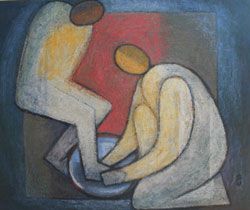
This is not to say that we must abolish the Old Testament and reject the God of Abraham, Isaac and Jacob. It means that if we accept Jesus as divine, we must reinterpret the Old Testament from Jesus’ point of view and try to understand the God of Abraham, Isaac and Jacob in the way in which Jesus did … We have seen what Jesus was like. If we now wish to treat him as our God, we would have to conclude that our God does not want to be served by us, but wants to serve us; God does not want to be given the highest possible rank and status in our society, but wants to take the lowest place and to be without any rank and status… If this is a true picture of God, then God is more truly human, more thoroughly humane, than any human being. God is, what Schillebeeckx has called, a Deus humanissimus, a supremely human God.
Albert Nolan – Jesus Before Christianity (p165-167)







 Curious Christian
Leave a comment