Curious Christian

Reflections on culture, nature, and spirituality from a Christian perspective

Mike Lowe has alerted me to a book launch coming up next week that may interest a few of you, particularly if you’re in Melbourne.

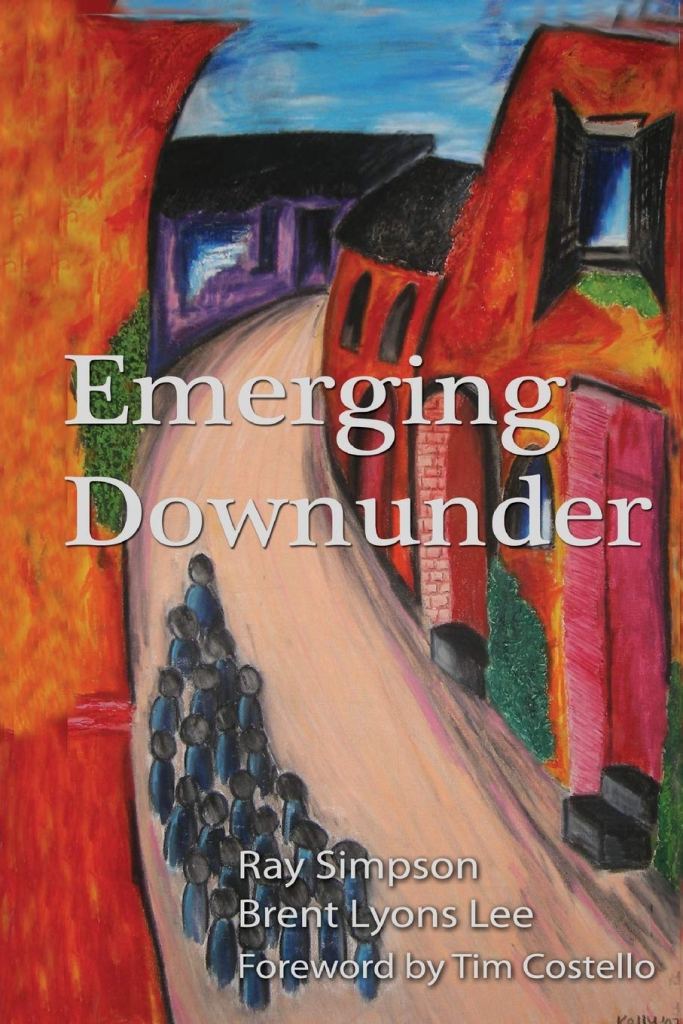
The book is called ‘Emerging Downunder’

The blurb goes: “Emerging Downunder: Creating Celtic New Monastic Villages of God taps into the current hunger for spirituality, the death pains of obsolete church forms, and the rising tide of hope felt by many Christians. It suggests ways the fragmented church may reconnect both with its roots and the contemporary environment, providing practical examples of church that bring praying, eating, learning and hospitality together in one place.”

“This book was first published as Church of the Isles by Ray Simpson for a British audience. In collaboration with Brent Lyons Lee, it has tapped in to worldwide conversations about ‘emerging church’ and ‘new monasticism’ and applied it to a ‘downunder’ context.”

Tim Costello will be launching the book in Melbourne at 6:30pm on Thursday April 3 at Credo Café, (The end of Baptist Place Laneway off Little Collins St between Swanston & Russell St.)

If any of you can make the launch I would be interested in hearing your take on it.

14 responses to “Emerging Downunder by Ray Simpson and Brent Lyons Lee”

  1. Brent Avatar
    Brent

    Hi Matt
    Thanks for the plug!!
    I’m glad I’m not a perfectionist, I don’t know if you could ever publish anything if you were… typos/better phrasing etc etc. I hope this is a conversation starter or enhancer. I had a long conversation with Peter Millar who is connected to Iona and Wellspring which is the Aussie expression. These guys have been exploring some of my questions for some time. I think that ‘celtic’ insights can really help us to explore our indigenous spirituality. Happy to be part of the conversation!

    Like

  2. Matt Stone Avatar

    Wellspring … is this the site here? http://www.wellspringcentre.org.au
    And thanks for joining in. A few questions if I may ask. When you say “our indigenous spirituality”, I would like to tease out what you actually mean by that. Are you referring to our ancestral spirituality (as Anglo Australians), native spirituality (of Aboriginal Australians) or something new in terms of how we relate to our landscape and our shifting culture? Also, I am interested in which celtic insights you find most helpful and inspiring?

    Like

  3. andrew jones Avatar

    cool. i will make sure i buy the book and have a chat with ray in melbourne next month.

    Like

  4. Brent Avatar
    Brent

    Ray will be speaking at the Wellspring Centre which is link you put on there Matt. But the Wellspring community website is http://www.wellspringcommunity.org.au/
    I basically wanted to write this after a pilgrimage to the the Holy Island of Lindisfarne in the UK a few years ago. I met Ray there and he is quite a mystic! I felt like an exile coming back to Australia and was confronted with what does an Australian spirituality actually consist of. David Tacey’s stuff really helped me Here are a couple of quotes from David that I use in the book…
    Tacey writes that the power of the land and the influence of aboriginal culture are activating primordial levels of the Euro-Australian psyche, stirring its deeper layers. He believes that a version of ancient Celtic spirituality is being awakened and stirred to new life in Australia. One can see this in many different ways in Australian folk culture, where the attempt to ‘grow down’ into Australian soil has the effect of revitalising Celtic roots, giving rise to a kind of Celtic revival.
    The other quote from David i use is picks up on the concept of rooted spirituality (in the good sense!)…
    In thinking about a title for this book, it was almost more appropriate to use the term ‘submerging’ rather than ‘emerging’. David Tacey writes that in contemporary postcolonial Australia, spirituality is entering our life from below, and the feet play a more important role than the intellect. He quotes Barbara Blackman as saying that if we want to ‘under-stand’ spirituality in this country we have to ‘stand-under’ our habitual logic and our usual perceptions, since that is the vantage point from which the spirit is found. Understanding calls us away from our conscious conventions.

    Like

  5. Paul Fromont Avatar

    Sounds really interesting Matt. Thanks for the heads up. Is anyone in particular going to be retailing it? Publisher website? I’d like to get a copy…
    Hope all is well with you.
    PAX

    Like

  6. Matt Stone Avatar

    Brent, I’d agree that the term ‘submerging’ often seems more appropriate than ‘emerging’ in our context. It more readily gels with missional-incarnational themes and suggests more about what we are responding to than that what we are reacting against, which in my mind is far more positive. However a question emerges: with postcolonial Australia also being a globalized Australia where Asian spirituality is increasingly amongst the influences making their mark, do you see tribalization (going back to our roots) and globalization (opening up to non-European influences) being in tension in some respects and how do you see the submerging theme playing out in this context?
    I would agree that Aboriginal spirituality certainly confronts us with how “ungrounded” and “non-indigenous” our inhereted forms of Christianity really are. Have you explored rainbow-spirit theology at all? I am wondering how that may inform this conversation. I am also wondering whether you see the celtic Christianity revival taking a different shape in Australia to what is happening back in Britain?
    Oh, and I should add, you’ve probably noticed I have an interest in Australian Christian art with my Aboriginal and Mambo albums off to the right of this page. Has the Wellspring community produced any art, poetry or music yet? I’d be very interested if so.

    Like

  7. Bec Avatar
    Bec

    Ooh – good questions Matt! They’re ones I’ve been struggling with for a while, although from a slightly different angle…I’m constantly trying to figure out how to remain open to different ways of seeing and being, without being in danger of losing myself or (worse?) co-opting that which isn’t and shouldn’t be “mine”. For example, here are material artefacts and rituals from other cultures that mean a lot to me (because of the work I do, contexts I work in etc), but at what point are you in danger of…well, belittling or misusing things?
    Sorry, not expressing myself very well, and I don’t really want to go into specifics here…p’raps something I should email you about!!

    Like

  8. Matt Stone Avatar

    I think I grok. Contemporary incorporating can sometimes be interpreted as cultural theft by more ancient traditions. Have been in conversations where similar issues came up – with NeoPagans who’d been taken to task by indigenous Animists and also with a peeved off Irish Catholic who was less than appreciative of New Monasticism. History, ancestory and identity issues become really important here. I think “responsible eclecticism” would make for a good blog topic but I’m happy for you to email if you don’t want to go into specifics online.

    Like

  9. Bec Avatar
    Bec

    Yeah, that’s exactly what I was getting at. It’s a tough one and I don’t think there are any answers that will satisfy anyone, because it does have so much to do with identity.
    You may well get an email from me in a few months when I’m halfway through fieldwork and more confused than ever! 😛

    Like

  10. Matt Stone Avatar

    I think one of the potential traps is romanticism about the ancient and exotic (and the obvious caution there is take a reality check and beware the noble savage myth). Another is consumerism where culture is sampled superficially without appreciation for context (with the caution there being, ask how this thing sat within the wider system). And another is not giving cudos where it is due (which can amount to identity theft if you are not careful).
    So, when it comes to Orthodox Christianity for instance, I might say their art inspires me and their theology prompts me into deeper reflection, but I admit my understanding is partial, I dialogue where I can (hi Steve!)to keep it real and I accept that whatever I incorporate into my own path from that tradition will in some senses be changed beyond recognition.
    This brings me back to one of my own questions above. I suspect that the New Monasticism will inevitably take new forms in Australia in the longer term. I suppose I am wondering if there are already signs of that.

    Like

  11. Chris Avatar

    I used to work at Credo, but I’ve since moved back to the US … so do you have any ideas on hwo I could get my hands on this book?

    Like

  12. Matt Stone Avatar

    Urban Seed says RRP $28.95. Copies can be purchased through Brent Lyons Lee. See
    brent.lyonslee@urbanseed.org or ph 0413 311 170

    Like

  13. Brent Avatar
    Brent

    The book is also available online at ATF Press http://www.atfpress.com/
    Just to pick up on a few comments…
    Wellspring have produced some music I believe and perhaps some poetry and art. I’m not sure who to contact but there may be some links on their website.
    I’m also caustious about the romanticism that you talk about Matt. I think its great to enter in to the mysticism of something that is ancient and unknown, but we do also need to keep it real! Perhaps that is a very Australian spiritual gift… keeping it real! Ray (as an outsider) is excited about Australia’s unique geographical postion and believes that we have the opportunity to really incorporate the best of western and eastern pracitices.It sounds a bit consumeristic perhaps, but we are still young enough in our traditions to find a mix of east and west which could be a shining light for the rest of the world. We haven’t elaborated a great deal on this in the book and probably would have if we had more time. The Holy Transfiguration Monastary in Geelong, Victoria have been a guiding light on the potential for this.

    Like

  14. Matt Stone Avatar

    Yeah, with regards to “keeping it real” Mike Frost has a great old article on “Evangelism as Risky Negotiation” which explores contextualization as a balancing act.
    http://www.cegm.org.au/articles/risky-negotiation.html
    It acknowledges the risks but also acknowledges “adopt[ing] rites drawn from our Christian heritage” is a legitimate part of the contextualization process within an an appropriately self critical framework. We Aussies do have a “gift” for self critique I agree! And eclecticism.
    Given our culture is so young and subject to so much global influence, eastern and western, I think we’re in a real melting pot situation here. It will be interesting to see what emerges over the coming decades.
    Maybe you could tell us some more about the core themes of the book?

    Like

Leave a comment