In my researches into the intersections between sexuality and spirituality I recently came across a very interesting and provocative book by Martti Nissinen, entitled, “Homoeroticism in the Biblical World”.
In the opening chapters Nissinen teases out the differences between sexual orientation, gender identification, gender roles and sexual practice, going on to observe how, in the ancient Mediterranean world, homoerotic practices were regarded as role constructions between active and passive partners, in a way that is quite foreign to how we think of “homosexuality.” Nissinen suggests this should shape how we interpret the ancient Torah codes and the writings of the prophets.
For example, in interpreting the destruction of Sodom (Genesis 19:1-11), Nissinen suggests it is very important to understand honour / shame codes:
“In a patriarchal society manly honour largely is equivalent to human value, to offend which is a grave shame. Gang rape of a man has always been an extreme means to disgrace one’s enemies and put them in their place. Its purpose is to disgrace one’s manly honour, to reduce one to a woman’s role…” (Nissinen, 1998, 48)
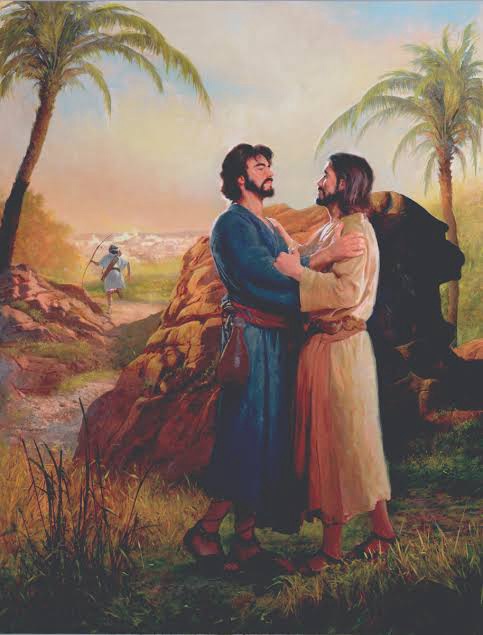
In interpreting the relationship between David and Jonathan (1 Samuel 18-20 and 2 Samuel 1:26), Nissinen distinguishes between homoeroticism (which involves sex acts and active-passive roles) and homosociability (which has more to do with the mutual expression of feelings between men).
“Modern readers probably see homoeroticism in the story of David more easily than did the ancients. In the contemporary Western world, men’s mutual expressions of feelings are more restricted than they were in the biblical world” (Nissinen, 1998, 56)
Examining Greek and Roman culture, Nissinen notes:
“What was common to both Roman and Green homoeroticism was the basic structure required an active and passive partner … in Greece this often meant adult men’s relationships with young boys … in Rome homoerotic relationships normally occurred between a slave and master.” (Nissinen, 1998, 70-71)
In other words, as we read there ancient stories and law codes it is very important for us to understand the power dynamics operating beneath the surface. The ancient Romans and Greeks regarded paedophilia as more socially acceptable than egalitarian homoeroticism precisely because of the power dynamics.
“Attitudes towards homoeroticism in antiquity were not based on an assumption of two distinct identities and orientations, “homosexuality” and “heterosexuality,” between which one made a moral choice.” (Nissinen, 1998, 79)
“Because masculinity was not a birthright but rather an achieved state of paramount moral significance, there was always a danger of loosing it … homoerotic relationships were a delicate issue, managed by a subtle moral code, the honour of a free born citizen being its primary concern. Thus, ‘what might appear at first sight as tolerance reveals, in fact, the comprehensiveness of the codes adopted by the elites.’” (Nissinen, 1998, 79-80)
“The acceptability of a person’s homoerotic behaviour [in Rome and Greece] depended on one’s social role and status, not on one’s personal identity. (Nissinen, 1998, 129)
So, were the ancient Pagans really more tolerant than the Hebrew prophets? Or were they actually more exploitative, at least as far as men were concerned? I think these are questions worth exploring for Christians and Pagans alike.
But enough of the past, what is the way forward? Nissinen observes,
“The catchword ‘love the sinner, hate the sin’ has had only meagre results … love is not about striving for an objective good but about putting oneself at risk for another human being. Stepping in the other person’s shoes, we can see ourselves in that person and love him or her. This means understanding the other person from his or her own point of view, even when the person’s lifestyle or opinions appear strange or wrong.” (Nissinen, 1998, 140)
I feel challenged, from reading this book, to recognize that the homoerotic practices the Bible condemns are at some variance to contemporary homosexual practice, that they’re grounded in honour / shame codes that are quite foreign to westerners, that the prophetic protests were more related to male degredation issues than I realised. I also feel challenged to question the much celebrated “tolerance” of the ancient Pagans. Most of all though, I feel challenged to take more risks in terms of how I relate to the gay community today. I think Nissinen is right, love involves risk.




 Curious Christian
Leave a reply to Janet Cancel reply