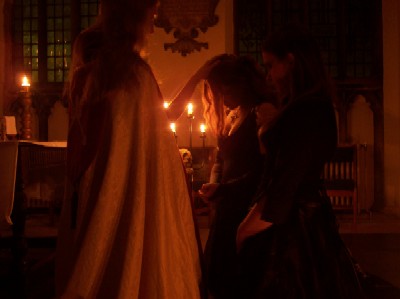

Friends from a Pagan-Christian interfaith forum brough a Goth eucharistic gathering to my attention. St. Edward King and Martyr Church, an Anglican in Cambridge, holds a biweekly service in the evenings for people who identify themselves as Goth. This is how it is described:
The service is candlelit with a specially written liturgy and uses a variety of modern rock and as well as classical music. The structure of the service revolves around the baptismal candle and reflects a serious engagement with the depressing and darker sides of our lives before moving towards a position of hope and happiness found in the empathy of the Lord Jesus Christ.
I subsequently came across a longer explaination in an article called Being Christian and Being Goth as http://www.thegotheucharist.org.uk.
BEING CHRISTIAN AND BEING GOTH
a challenge for the Churches by Marcus RamshawA Christian Goth may initially seem to be an oxymoron. Goths, in terms of today’s sub-culture celebrate, with both an ironic and cynical attitude, an approach to life which is frequently both nihilistic and fatalistic. Christians, in contrast are associated with a joyful, faith-filled and positive approach to life, full of hope and a strong belief in redemption. The gothic view of life appears to be a stark contrast to the Christian one.
Modern day ‘goths’ tend to identify with each other through their musical tastes and dress sense, yet even then, there is less distinction made between a poseur, wannabee goth, more concerned with image and a real, committed approach to an outlook on life which is more authentically ‘gothic’. In reality, the ‘gothic imagination’ draws heavily from a variety of sources – literature, film, taste and philosophy, as well as music and fashion.
Trying to define a ‘modern day goth’ is a torturous exercise. Most goths themselves refuse to acknowledge the label. They continually debate amongst themselves what is ‘gothic’ and what is not. The two most obvious areas of group recognition – music and fashion are not, in themselves, as helpful as you might think. In music there are some obvious mainstream bands such as Joy Division, Depeche Mode, Nine Inch Nails, Siouxsie and the Banshees, Christian death, Nightwish etc, though even with these there is some debate about their gothic credentials. However the gothic imagination didn’t simply start as a reaction to punk music in the late 1970s, it has a much older pedigree. In music what could be more gothic than the works of Wagner or even the music that originated from medieval plainsong?
In terms of fashion goths are stereotyped as the people who wear a lot of black and sometimes add white make up with black eyeliner. For goths wearing black is often the default option in their wardrobe. Many goths delight in luxurious rich colours, incorporating purple, red and dark blue. There is often a fascination with pre-raphaelite art which incorporates a vibrant array of colours. Gothic dress is more about making a statement which is invariably theatrical, rather than simply wearing black.
So what makes you a ‘goth’ in the 21st Century? I think it is principally a state of mind, an attitude towards the world, a way of viewing life and those around you. For the modern day goth this is a deep identity with the darker dimensions to our existence. They feel that they don’t fit in with conventional or ‘respectable’ society. They regard themselves as different and often misunderstood by the wider world. It would be too simplistic, however, to regard this outlook as an entirely bleak approach. There is a longing for something more from the world, though with little expectation that this will materialize. There is often a deep-rooted desire for a more inclusive and non-judgmental world. Nancy Kilpatrick in ‘The Goth Bible: A Compendium for the Darkly Inclined’ observed that:
‘…saying goths are lonely and morbid is misleading. The mainstream views Goths through a distorted mirror that sees only dreary music coupled with Morticia Addams fashions. Most Goths and kindred souls dispute that shallow reflection. Romance is at the heart of what it means to be Goth, and consequently tragedy is always a sigh away. In the modern gothic world, as in few other realms, the outward trappings of similarity belie fierce individuality. Every goth is an individual first and foremost, adamantly defending that position. Yet lurking within such independence is the intense need for community, which is glaringly obvious to anyone who cares to look ’
In a sense, a gothic mentality is one in which your dreams and desires are being destroyed by a harsh, unforgiving world. You are left alone and need to work out your response. You both give up and sink into despair or you accept your fate as a being misunderstood and maligned by wider society. The most important thing, whatever you do, is to be true to yourself.
There is a great deal of integrity and honesty in the gothic approach to life. The one characteristic goths seem to share with each other is a willingness to be open and frank about the darker side of their lives. Pain and heartache are taken very seriously. Many modern day taboos in contemporary society such as self-harm, suicidal thoughts, depression, grief, failure and fear will resonate with goths far more powerfully than most other modern sub-cultures would realize.
So what can Christianity offer? Caitlin Moran in ‘The Times’ made a comment on the Goth Eucharist which has been running at St. Edward’s Church in Cambridge for the past 15 months, a particularly thought-provoking comment. She wrote how:
‘…church services are all about a misunderstood man who got nailed to a cross. They are held in a looming, bell-towered, candle-lit edifice in the middle of a graveyard. Indeed if you go catholic, you get to burn incense and drink blood, as well. By contrast, playing a bit of Rasmus looks a bit, well, townie.’
There are some obvious parallels between the gothic imagination and the aesthetics of Christianity but perhaps the greatest is how both the Christian Churches and the gothic imagination have consistently misunderstood each other and viewed their relationship as both antagonistic and hostile. Goth culture is often dismissed as tainted with Satanism or Wicca, with outrageous excess and decadence, as unrespectable and even unholy. Goths who regard themselves as Satanists are, in fact, few and far between. Pagan beliefs are more likely to be found in goth communities, though only amongst a minority of goths. It is sometimes seem as an attempt to parody the Christian faith and expose its emptiness in face of the harsh realities of life. Goth culture in response has had a tendency to view the mainstream Churches as both hypocritical and judgmental, interested only with the an outlook on life which is wrapped up in the hymn ‘All Things, Bright and Beautiful’ – a patronizing response to the deeper psychological and emotional hurts that life can throw at you – a response to the world which is more triumphialistic than it is tolerant of others. From a gothic viewpoint Christianity is equated with middle class respectability. The words of Christ in Matthew’s Gospel:
‘The Son of Man came eating and drinking, and they say, ‘Here is a glutton and a drunkard, a friend of tax collectors and “sinners.”’
But wisdom is proved right by her actions.”, does not appear to be a message that contemporary Christians are willing to preach. It has, rather, become something of an embarrassment. Gavin Baddeley’s summary of the gothic world view is that:
‘Gothic is sophisticated barbarism. It is a passion for life draped in the symbolism of death. It is a cynical love of sentiment. It is a marriage of extremes such as sex and death. It uses darkness to illuminate. It believes duty is vain, and vanity to be a duty. It is the compulsion to do the wrong things for all the right reasons. It is a yearning nostalgia for the black days of a past that never was. It denies orthodox reality and puts its faith in the imaginary. It is the unholy, the uncanny, the unnatural.’
Any attempt to define the relationship between modern day goths and modern day Christians can only be a generalization and, open to the accusation of being a simplistic one. Baddely is certainly more hostile towards Christianity than Kilpatrick is. Nevertheless a wide gulf has clearly emerged between contemporary Christianity and ‘gothdom’. Occasionally this is crossed by individuals, such as Anne Rice, a leading gothic horror writer who converted to Roman Catholicism in 1998 and wrote a biographical account of Jesus Christ as a young boy. Such instances seem, on the surface at least, to be quite rare. How might this gulf be crossed and how disenchanted has modern day ‘gothdom’ become with established religion?
The divide that has emerged between the goth culture and the Christian faith is not an unbridgeable one. The Christian faith has, historically, included a strongly dualistic element in which the reality of evil and despair is acknowledged. Christianity readily acknowledges a darker side to our existence in a fallen world. This engagement with the nighttime of the soul runs throughout the Bible and the development of Christian thought. The Old Testament contains numerous stories with which modern day goths would resonate with. In King’s the tragic story of King Saul raising from the dead the soul of Samuel, only to learn of his own death, resembles the imagery employed by writers of gothic horror. The Psalms, in particular Psalm 88, in which there is no happy ending, reflect the suffering and sense of loss which the human condition experiences. The Book of Ecclesiastes reflects a sense of despair and futility towards life. In Ecclesiastes life is full of vanity which can only lead to destruction.
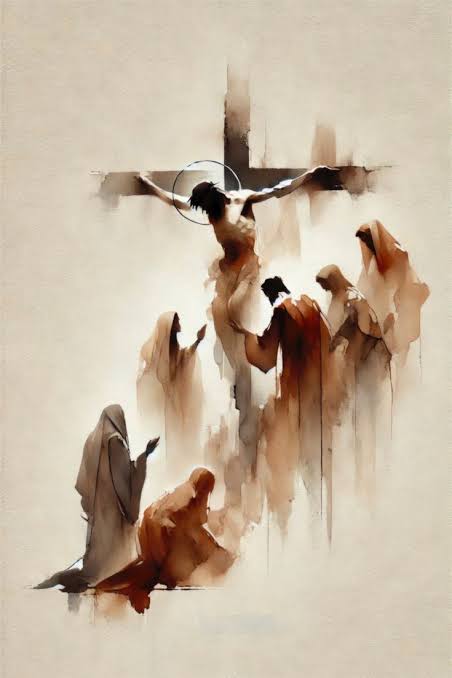
In the New Testament the gothic outlook on life pervades the ministry of Christ, culminating, in its most dramatic form with Christ’s words on the cross;‘ My God, My God, Why Have You Forsaken me?’ An engagement with the darkness and despair that attacks human existence is an underlying theme throughout the Gospels. The presentation of this faith by contemporary Christians, however, often places its greater emphasis on the Resurrection of Christ, whilst, largely, glossing over the extent of his suffering. This is perhaps particularly true of the Anglican approach, although even modern day Roman Catholicism has reacted against dwelling upon the Passion of Christ. Certainly, from the viewpoint of a modern day goth suffering in life is glossed over and not taken seriously enough.
It is also important to recognize the deep influence Christian culture has had on the ‘gothic imagination’. Religious imagery is frequently used in the lyrics of goth bands, the aesthetics of gothic architecture and design have heavily influenced gothic fashion, and the curiosity with the preternatural may be seen to stem from the hole left by the absence of Christian spirituality.
In January 2005 a new service was set up at St. Edward’s, King and Martyr Church in central Cambridge. Each alternate Tuesday, the Goth Eucharist used music from contemporary goth bands instead of traditional hymns, a specially written liturgy drawing on a dualistic approach to life, a vast array of candles, the use of incense and high church rituals to create a worshipping atmosphere which draw heavily on the aesthetics of goth culture. As the service developed between twenty and twenty five goths from Cambridge attend the service, all in gothic dress. The service includes both biblical and secular readings as well as a brief homily of 8-10 minutes which directly tackles issues such as anger, depression, doubt, grief, self-harm and suicide. On special occasions, such as St. Valentine’s Day, 2006, the service focused on ‘Broken Relationships’ and those attending were encouraged to walk and crush red roses, strewn on the church floor, whilst going up to receive Communion or a Blessing. The service began as a liturgical experiment but gradually established itself, formed its own internal worship committee and attracted a wide amount of television, radio and press coverage, both nationally and internationally.
The group of goths that attend the Goth Eucharist in Cambridge provides a snapshot of the relationship between contemporary goths and, in this case, the Anglican Church. Several surprising facts emerged. An unexpectantly high number of those attending the Goth Eucharist had been confirmed. More than half of those attending had formerly been regular church attendees during either their childhood or teenage years. The average age attending the service is the early-mid twenties. In several instances the service attracted people who had felt previously let down or hurt by their previously relationship with organized religion. In a sense, a significant number of those attending were not, in the words of the Gospels, the lost sheep from the Christian fold; rather they represented ‘the sheep that got away’. Most missionary endeavours from the Churches focus on attracting newcomers to the Christian community. Those who used to come, but do so no longer, are frequently forgotten.
A random poll of local Goths in Cambridge was carried out online via a ‘Live Journal Community’, entitled ‘Christianity and Goth’ in late January 2006. The community was the main goth community in the area – called ‘Camgothcalling’. The poll can only be regarded as a rough indication but the results revealed a higher number of those identifying with Christianity than many might have expected. 67 individuals took part in the survey. They were asked if they defined themselves as (i) Christian, a bit Christian or not Christian and (ii) goth, a bit goth and not goth. 23 individuals (34% of the total) defined themselves as either Christian or ‘a bit Christian’ compared to 58 of the same individuals (76% of the total) who defined themselves as either ‘goth’ or ‘a bit goth’. In summary, either one-third (or one quarter, if allowance is made for those who did not define themselves as goth is made) claimed an association with the Christian faith. The survey clearly refutes the idea that a ‘Christian goth’ is an oxymoron.
A third aspect was that, several attending found the spirituality of the act of worship deeply moving and of pastoral value. A growing number of people make a distinction between being ‘spiritual’ and being ‘religious’. Although the Goth Eucharist is unequivocally orthodox in mainstream Christian theology, several worshippers were clear that they would attend this act of Christian worship but would not normally attend any other Church service.
A fourth, unexpected development, was the degree of interest shown in a T-shirt which was designed to promote the service. The design was a simple one, a long-sleeved black shirt with a quote from St. John’s Gospel divided between the front and back of the shirt. The front simply said ‘If the world hates you….’ And the back continued with ‘…..remember, it hated me first.’ The quote was taken from Jesus’ farewell discourse in St. John’s Gospel. The shirts proved to be remarkably popular, both with those attending the service and those who simply heard about it through the media. The ‘gothic sentiment’ expressed in St. John’s Gospel was the principal factor in the t-shirt’s popularity.
The Goth Eucharist remains an ongoing act of worship. As a regular service, it is unique in the Church of England. The Annual Christian Arts Festival at Greenbelt has, in recent years, hosted a goth Eucharist and Coventry Cathedral has been developing a ‘goth Ministry’ through its Youth Officers. The service in Cambridge is, however, the only regular ‘goth service’ taking place in a Church of England parish church. The service does highlight the possibilities that exist for the Established Churches to develop both a pastoral and evangelistic opportunity to connect with part of modern culture which, in the past, it has overlooked.
However, in order to do this, preconceptions and prejudices on both sides need to be challenged. For the Churches the Christian faith must not be confused with the appearances of ‘respectability’. The answer to serious emotional and psychological problems in life lies not with simplistic solutions to them but with an empathetic understanding and a willingness to meet people, with their own spiritual and religious doubts and questions, where they are. This is far more important than any attempt at ‘conversion’ Any effort made by the Church to build a relationship with goths must start from a desire to accept people as they are, rather than a covert attempt to change them. For the goth community there are, perhaps, fewer obstacles to be overcome. The greatest of these perhaps is a challenge to their perceptions of God and the Christian faith, to develop a greater appreciation of the dualistic strain that is inherent in the Christian world view and a willingness to accept that being a Christian and being a goth are not incompatible. There are, after all, Christian goths in their midst.



 Curious Christian
Leave a reply to Call Me Ishmael Cancel reply