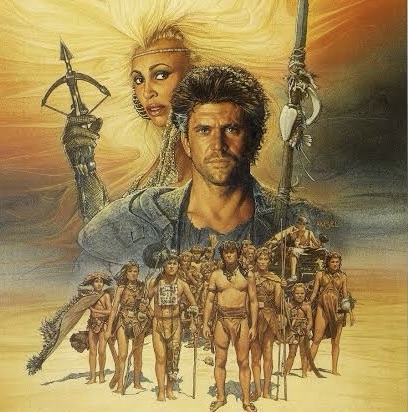
In his article “Junkies, thieves, idiots and depressives” David Dale explores what makes Australian culture and mythology distinctive, and what make foreign imports unpalatable.
Apparently the film-makers of Australia have taken to heart the theme song of Mad Max 3: “We don’t need another hero; We don’t need to know the way home.” They seem to agree with the Hollywood screenwriter Christopher Vogler that Australia is a “hero-phobic society”. And with the actor-director Steve Vidler that we suck at triumphalist movies because we have the wrong founding myth.
Last week this column celebrated the 20th birthday of Crocodile Dundee by asking why Australia doesn’t make hit movies of that kind any more. We got impassioned responses from 87 readers.
Part of the answer may lie in the theories of Christopher Vogler. He became hugely influential from the mid-80s after he wrote a memo to his bosses at the Disney studio claiming that all successful stories — even the silliest comedies — involve a classic plot structure he calls “The Hero’s Journey”. He says human beings are genetically programmed to respond to certain characters (archetypes) and to this progression of events: a person is summoned on a quest, meets a mentor and new friends along the road, overcomes obstacles, enters the inmost cave and confronts the ultimate evil, goes through a form of death and resurrection, and returns home with “the elixir” — an idea that saves his tribe, or love, or self-knowledge. The most obvious example of this structure is the original Star Wars.
But in the second edition of his book, The Writer’s Journey, Vogler wonders if his outline might be a tool of American imperialism: “My Australian teachers helped me see that such elements might make good stories for the world market but may not reflect the views of all cultures … The Australians distrust appeals to heroic virtue because such concepts have been used to lure generations of young Australian males into fighting Britain’s battles.
“Australians have their heroes, of course, but they tend to be unassuming and self-effacing, and will remain reluctant for much longer than heroes in other cultures. In Australian culture it’s unseemly to seek out leadership or the limelight, and anyone who does is a ‘tall poppy’, quickly cut down. The most admirable hero is one who denies his heroic role as long as possible and who, like Mad Max, avoids accepting responsibility for anyone but himself.”
Like all broad brush stroke generalizations I am sure this can be picked apart – the Australian psyche is becoming a lot more complex in the face of multicultualism – but as a broad brush stroke look at Australian culture and mythology I believe there is a strong grain of truth here, and consequently, some important things for Christians to take on board if they would contextualize Christianity for post-modern Australians.
Post-modernity, if anything, seems reinforce our mistrust of heroic mythologies (read: metanarratives), particularly those which transparently serve foreign interests. Witness Aussie cynicism to Axis of Evil language, even amongst those Aussies who are strong supporters of John Howard and the War in Iraq. Any suggestion that John Howard should adopt such language is generally greeted by laughter or worse. And the suggestion that Aussies should make an Australian version of the movie “Airforce One” usually has people rolling in the aisles. “Honest” John says’”G G Get off my plane!” LOL
So consider more closely this statement:
“Sometimes we try to appropriate the American myth for our stories. And a strange thing happens. Mostly Australian audiences will not believe it.”
The article focusses on myths of a cinematic variety but what about metanarratives of the more religious variety? What about the stories we live in as Christians and the stories those in the Emerging Church conversation tell about themselves and the society we live in? How believable are the global conversations to ordinary Australians? Many aren’t believable even to me.





 Curious Christian
Leave a comment