Curious Christian

Reflections on culture, nature, and spirituality from a Christian perspective

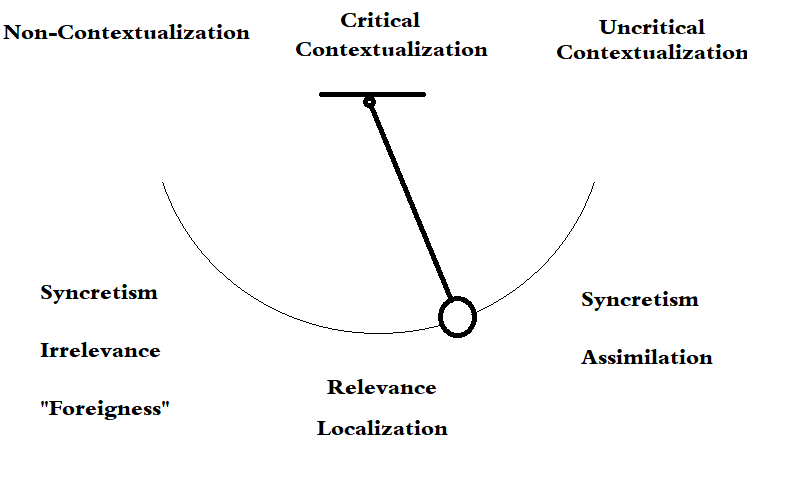
But how far is too far?

The Cornerstone Festival is coming up again and John Morehead is asking some interesting questions in the lead up:

“When does “contextualization” cross the line into syncretism? Western Christians are not used to appreciating the importance of this question in “Christendom” culture, but the shift to post-Christendom and increasing religious pluralism make these the leading questions for faith and living in the twenty-first century.”

I agree, but what saddens me is that unfortunately it is not a question I often hear asked in emerging church circles. With all the focus on detoxing from fundamentalism, and so few of us being direct Christian converts from secular spiritualities, there is too little appreciation of the urgency of the syncretism problem lurking at the opposite extreme.

12 responses to “But how far is too far?”

  1. Jason Pitzl-Waters Avatar

    As a modern Pagan I have a somewhat different take on syncretism. I’m sure its troubling for Christians to think that they are unknowingly nurturing un-Christian practices, but I feel that syncretism is an unavoidable byproduct of invasive missionary work. It is folly to think you can keep the dances, dress, and songs while abolishing the non-Christian religions. They are all intrinsically linked. So long as a cultural trace remains the seeds for syncretism, revival, or reconstruction will always exist.
    The “Church” (however you want to define that) has two choices, either perform (or actively participate in) cultural genocide and intensive “reeducation” (as was nearly done with Native Americans) or tolerate syncretism so long as the public is outwardly “Christian” (as seen in the Afro-syncretic faiths) and hope that over time they will grow ever more Christian. Both styles have been tried to varying degrees of “success”, but I think no missionary effort no matter how effective in practice will ever wipe out syncretism, for the simple reason that polytheism is how (I believe) we are “wired” (see the works of Jordan Paper and Michael York for more on this theory) and continues even after we have cast away the outward trappings of non-monotheist faith.
    To my ears, “syncretism” fills me with a sort of joy. It means that some part of pre/non-Christian religion, no matter how debased, continues to exist despite efforts to the contrary. Of course even Christianity itself is “syncretic” in a manner of speaking. The Christianity that most people practice is very far from that of the first Christians (who were, of course, Jews). Paul was perhaps the first Christian making use of syncretism to strengthen his young faith, and this has continued as Christianity has tried to spread. Of course some will argue that those pre-Christian/non-Jewish elements have been “sanctified” or “Christianized”, but I’m sure some modern Santerians might tell you the same thing.

    Like

  2. Brendan Avatar

    There’s a syncretism problem? What sort of problem is it? Since Christianity in all its forms is synchretic (recognizing that syncretism in Xianity is just a matter of knowing the history of mythology), how could syncretism itself ever be considered a problem for a “Christian,” without necessitating a harsh look in the mirror?

    Like

  3. Sun Warrior Avatar

    Is Christ a micro dot surrounded by thick culture? It sounds so rarified, like an actual encounter with God Himself.
    The state of the soul is what Christ was concerned about, and He would get Christians through the mess of living in civilization, if we believed in Him and trusted Him. Understanding the God-spark in us, and making it grow, despite what society does to us. In this way, we could change the animal nature of humans, living in the savagery of Nature and society could be converted into the love that exists outside of this finite Creation.
    That’s pretty basic. And I guess it is the basis of the contextualization issue. The fear of syncretism sounds like the dilution of the purity of Christ.
    How to be spiritually pure while we are animals by nature, further infected by civilization? We can never be wholly pure, but our faith will carry us through to that purity in the afterlife.
    Never thought of Jesus as the conversion of the purity laws of Judaism. I always thought He preached against it. But guilt and perfection, fear and hope, is pretty much about purity.
    Interesting distinction, of isolating humans so that we can be a part of God. Kinda explains a lot about Christian paranoia, and the rise of science after all other spiritual knowledge was abolished. Modern society is about the Christian condition of the human alone in inert matter trying to find God. What makes us so lonely when the Church made it so obvious?
    God as ‘other,’ Nature as ‘other,’ and humans caught in between. Quite the journey in between. What is the fatigue level of maintaining our spirit in the laboratory of Christ, the way we interpreted Him, forsaking all others as His bride? There seems to be one level of understanding of Christ that the Church is still missing.

    Like

  4. Sun Warrior Avatar

    After doing the dishes, I guess the Christian question is how do people understand and experience God? Is it through Christ, or some weirder version of the Creator that doesn’t do the trick?
    This is a very valid point. If Christians understand that their spiritual reality is limited, but true to the Truth of Christ, then they have a good checklist to judge the workings of other spiritualities.
    Do they include the Creator? What is their interpretation and relationship? Does it compare to Christ, or off-base? Perhaps it can add something back into Christianity that the Church discarded earlier. Perhaps it reconnects God, Nature and humans into a spiritual whole, something the Church sacrificed in its absorption of other ancient thought. It is okay to think positively of humans, after the Renaissance re-discovered classical civilization. Maybe it is okay now to stop dividing Creation in human minds and start re-uniting it.

    Like

  5. Matt Stone Avatar

    Jason, I agree that syncretism is always a risk and is not going away in a hurry, I am merely drawing attention to the fact that many emerging church bloggers are unaware of that risk, or if not unaware, don’t really appreciate what missiology has to say on the subject.
    As for choices, I would say we have a third choice to cultural genocide and syncretism, and that is contextualization, precisely what I am advocating. Like syncretism, contextualization incorporates elements of the indigenous religion. The difference is that it engages in a manner that is more discerning and with more integrity from a Christian perspective. For example, in Africa contextual Christian movements have arisen which give a much higher prominence to African spiritual concerns than European churches. So much so that many western Christians find it quite alien. Yet this may still be contrasted with Voudou which is genuinely syncretistic. I agree Paul’s practice was innovative but his method is precisely what I mean by contextualization. Christ remained at the centred of Paul’s practice even as he molded Christianity to his Roman pagan context. He dropped the kosher laws and incorporated quotes from pagan philosophers into his teaching, but stayed true to Jesus.
    Syncretism is different, often it involves imposing Christian customs on a culture while simultaneously sidelining Jesus. In some ways it does more violence to both Christianity and the culture than what I speak of.

    Like

  6. Matt Stone Avatar

    Brendan, I would ask you to clarify your point or possibly add an example of what you are trying to get across.

    Like

  7. Matt Stone Avatar

    Sun Warrior, Christ was concerned about far more than the soul. In fact, far from the soul being central to his teachings the truth is Jesus hardly ever mentioned it.
    Soul-fixation was more typical of Gnostic metaphysical dualism, and in so far as you find it in Christianity that is what I mean by syncretism and one of the things I find problematic.
    What was far more central to the teachings of Jesus was the Kingdom of God, a dream of what the created order would look like if the God who restores justice, not the forces of oppression and exploitation, sat on the throne of the world. He articulated a vision of harmony restored to society and the entire universe, a vision that encompassed far more than inert matter and humans. The renewal of creation was very much a part of his vision and the Bible articulates that quite clearly.
    Nature is not other. That is a Gnostic dualist position, not a Christian monotheistic position. Our hope includes restoration of relationship with all life.
    The path Jesus offered didn’t require people to be pure, no, it required people honest. Syncretism is problematic because it, by definition, involves a sidelining of this man who would put honesty over purity.

    Like

  8. Matt Stone Avatar

    How do I experience God? I experience God through the rushing of the wind through my hair, through the crashing of the waves on break walls, through the smile of a child, through the healing of the sick, through the lifting up of a victimized woman to strength and wholeness, through the busy activity of an ant – watched on a hot summers day, through dolphins smiming beside me as I walk along the beach, through coincidences and syncronicities in life, through all that is beautiful, good and true.
    I experience God through the best I that find in other religions – in Pagan respect for the environment, Buddhist and Taoist wisdom, Sufi poetry.
    I experienced God in meditation, in composing poetry, I experience God through welcoming strangers, and giving, and, at times, even in church. I experience God through communion and reading the sacred stories we call the gospels. Most of all, yes, I experience God through Jesus. Jesus is not the only window to God, he is merely the clearest one, through whom the vista is wide open.
    It is more difficult to see God in some things – in genocide, in persectution, in paedophilia. I’ll be honest, some things I find very opaque in terms of being able to see God through them an in them. I mean, I know God is in everything, somewhere, but sometimes I have to take it more on trust.
    But in Jesus – God becomes unsubtle.

    Like

  9. Brendan Avatar

    An example of syncretism in “Christianity”? No problem. The incorporation of Jewish mythology into a larger picture mixing that mythology with ideas of the Greek/Egyptian Mysteries, drawing on Plato’s Timaeus for the “Holy Trinity,” and the work of Neo-Platonists of the time like Philo for the Logos.
    It isn’t hidden that Christianity swallows Judaism by incorporating it into a new synchretic mythological system along with other major features of the intellectual mixing pot of the Hellenistic world. As Campbell, Hegel and others have amply demonstrated, that is the essential method of mythology – competing cultures merge into a new synthesis.
    For mystics, of course, there’s no “problem” with synchretism because we don’t get caught in the signs and symbols anyway. Mystics never understand them as anything beyond the poetry and metaphor that points toward direct experience of the Divine, the Absolute, or the Cogitant. One who experiences Christ mystically would have no problem experiencing Christ through the poetry and metaphor of Paganism, philosophical naturalism, Islam, Taoism or any other creative mythology. This sort of mystical synchretism is what we see in the genuine epistles of Paul and the Gospels attributed to “Mark” and “John” when read as mythology rather than history or Theology (i.e. as a path rather than an end in itself).
    Does that clarify things?

    Like

  10. Matt Stone Avatar

    Not really because I see John’s incorporation of the logos language from Pagan culture as an example of contextualization, not syncretism. John uses logos to articulate the significance of Jesus, not to take the focus off Jesus.

    Like

  11. Brendan Avatar

    That’s fine. All arguments are matters of semantics. You can choose whatever definitions of “synchretism” and “contextualization” you want (words only have the meanings that individuals give them after all). Obviously, you and I are applying different meanings.
    The original TEF definition of “contextualization” was the translation of Biblical ideas into cultures that had not heard them (an arrogant enterprise for the reasons Rosemary Ruether explains). If that were the definition we were agreeing to use (and it’s the one I assumed we were agreeing to use), then you’d have it backwards. John brought the Logos from Greek philosophy into a new mysticism drawing its mythology from Jewish tradition and scripture, i.e. syncretizing Greek philosophy and Judaism (and some other stuff) into a new mix. It would only be “contexualization” if the broader meaning was the Greek philosophical Logos rather than its specific “incarnation” in the person of Jesus. That would mean that without any “Jesus Christ” to serve as the cultural context, it would still have meaning. I doubt that’s what you mean. That notion would be unacceptable to most self-identified “Christians,” whether Fundamentalist or not.
    But you’re of course free to define words any way you choose.

    Like

  12. Sun Warrior Avatar

    Your response to my comments were beautifully put, Matt. Thanks. You get no argument from me on that.

    Like

Leave a comment