Curious Christian

Reflections on culture, nature, and spirituality from a Christian perspective

Ecumenism? Or Eclecticism?

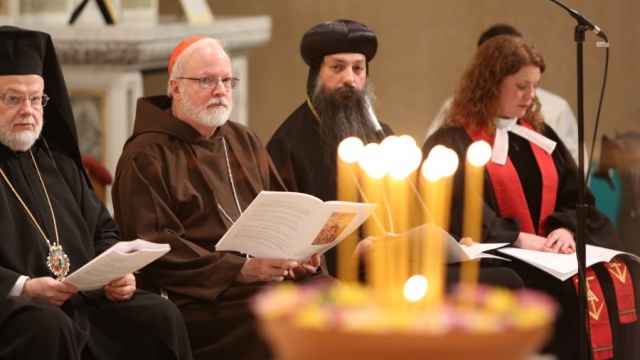
I wonder at times how clear some Christians, particularly Emerging Church Christians, are on the difference between ecumenism and eclecticism.

I wish I had some concrete examples to back this up, but I recall on a number of occasions coming across Christians here and there, calling themselves ecumenical on the basis of their willingness to incorporate the perspectives of other Christian traditions within their practice. “But that does not make you ecumenical”, I said aloud reading this, “that only makes you eclectic!” Are you actually in dialogue with Christians from other traditions?! The available evidence suggested not.

When people describe the Emerging Church as an ecumenical movement, to me it beds the question, how many widespread is ecumenical dialogue within it? When I get singled out as a blogger who is particularly open to other paths and traditions, and I only dialogue with a few Orthodox and Catholic Christians, it suggests, not much. Maybe it’s more of an ‘aspirational’ value like some much else?

11 responses to “Ecumenism? Or Eclecticism?”

  1. Makeesha Avatar

    hmmm….I dunno, I would probably consider myself ecumenical..really truly so. Although in our community I wouldn’t call ourselves ecumenical because that’s not actually what we’re going for, in fact, we’re probably shooting more for eclectic even though our lives reflect ecumenism.
    It strikes me that many of the emergent “heavies” are as well.

    Like

  2. Geoff Pengilly Avatar

    Hey Matt,
    I noticed your email bounced back. Do you have a new one?
    cheers G.

    Like

  3. sally Avatar

    I would describe myself as broadly ecumenical- my job requires me to be in dialogue with folk from other denominations, I find this dialogue both enriching and challenging- it is through the dialogue that I have become more ecletic- though having said that I would say my ecleticism strays beyond “orthodox” boundaries- so I live also with questions of possible syncretism! Spirituality is a strange thing!
    Regarding the Emerging church I would describe this movement as more ecletic than ecumenical- the tendency towards pick and mix Christianity in some ways reflects New Age tendencies…. but I’m never popular for saying so…..however it would be enriched by deeper dialogue, if only it were able to enter into it!

    Like

  4. Makeesha Avatar

    sally – – I don’t believe anything can be truly ecumenical so maybe that’s why I don’t share that critique of emergent.

    Like

  5. sally Avatar

    I agree that nothing can be truly ecumenical- but there is a need for openess over critisism!

    Like

  6. Matt Stone Avatar

    Yes, the reason I voice this criticism is that I would like to see the Emerging Church become genuinely ecumenical. When Brian McLaren was in Australia about a year ago I challenged him on claims that the EC was ‘post-liberal’ as well as ‘post-fundamentalist’. I said, ‘I don’t see much evidence of that, and as a person who is better described as a post-liberal (or post-pantheist to be more exact) than a post-fundamentalist I feel quite out on a limb at times within the movement.’ His response was to quote people who had read and been influenced to some degree by post-liberal writers, people I am familiar with and who in most other respects are better described as post-fundamentalists. But he couldn’t actually quote any genuine post-liberal writers that Emergent was in dialogue with. Now don’t get me wrong, I respect Brian greatly as a writer, but I think this is an area where EC rhetoric has run ahead of praxis. Now, the Ecumenical Movement is generally defined as ‘a movement aimed to promote understanding and cooperation among Christian churches; aimed ultimately at universal Christian unity’ (wordnet.princeton.edu/perl/webwn) or words along similar lines. I don’t see how genuine ecumenism or unity can occur in a near dialogical vacuum. This is not a call for perfection, just a call for some self-critique in the hope for the emergence of something more substantial, in the hope that more will take up the challenge of entering into genuine dialogue with Catholic and Orthodox Christians (not to mention post-liberals!). I know genuine ecumenism occurs in spurts here and there amongst EC leaders but it can hardly be described as a characteristic of the Emerging Church movement as a whole. I think it would be a good thing if only to aid our eclectic experimentations with some critical reality checks from those whom we’d co-opt material from.

    Like

  7. John Avatar
    John

    I think these brief quotes from my Spiritual Master are pertinent when the topic of ecumenism comes up.
    Truth Itself—or Reality Itself, Which Always Already IS the Only Real God—must, in the scale of human space and time, be universally Affirmed as the necessary, inherent, and Only context of human existence, both personal and collective.
    Truth IS the Self-Radiant Beauty, or Self-Existing “Brightness” of Being—Self-Evident, Self-Realized, Self-Manifested, Full, Indivisible, and Inherently Sufficient…..
    There is no religion greater than Beauty Itself!
    Where There IS Always Already Only Beauty Itself— One and Indivisible , AS Beloved of the Hart—what religion OWNS The Holy “Brightness”, That Transfigures every figure like a “Midnight Sun”.
    From: http://www.adidam.org/flash/truthandreligion/index.html
    Plus other quotes:
    “Therefore, True Religion must retire to Light!
    The heart must be permitted to achieve a universal feeling-ecstasy!”
    “The Realization of the Beautiful Is the purpose of True Religion.
    The Realization of the Beautiful IS Yoga.
    To Realize the Beautiful is to make Yoga of all things.
    All is Energy—and Energy Is all there is.
    Look again—and find the Beautiful, the unlimited, the Conscious Light, the “Bright” of Consciousness Itself.
    What else is of interest? What else is Reality? What else is Truth? What else are YOU up to?
    How much Light are you willing to allow into the room?”

    Like

  8. Matt Stone Avatar

    In what way do you consider that ecumenical John?

    Like

  9. Makeesha Avatar

    I don’t even know what post liberalism is….or post fundamentalism for that matter. and I guess I don’t really know what true ecumenism according to you matt…SOOOO…I guess I have some studying to do.

    Like

  10. Steve Hayes Avatar

    Someone on another blog referred to “post-denominational”, and I asked what that meant, but never got an answer. There are so many things described as “post” something or other, and i wonder if post isn’t just a filler noise like “uh” that people use when they are not sure what they want to say, I mean, like you know.
    There are well over 10000 denominations in South Africa alone, and the number is growing all the time – not exactly a situation one could have described as “postdenominational”, I would have thought.

    Like

  11. Matt Stone Avatar

    I understand the phrase “post-denominational” as a sort of short hand for referring to the increasing fluidity of Protestantism within western countries like Australia and the US.
    Not only are people switching churches more frequently these days, but when they do so the denomination of the church being moved to is more and more being reduced to a secondary consideration. Other factors, such as worship style, theological orientation and even ministry options have assumed greater importance. So we find charismatic Anglicans switching to charismatic Baptist churches in preference to litergical Anglican churches and stuff like that.
    At its worst it represents nothing more than a consumer mentality (in which case it gets referred to as “church shopping”) but just as often it can reflect the increasing irrelevance of old denominational disputes and division lines for some Christians in the face of contemporary issues.
    As someone who identifies himself as an eclectic Christian I suppose I wouldn’t exactly object to being labeled post-denominational. I attend a Baptist church but I don’t get too worked up over Baptist distinctives and my influences are far wider ranging. The problem with all “post” labels though is that they say more about where you’ve come from than where you’re going or where you are.

    Like

Leave a comment