Curious Christian

Reflections on culture, nature, and spirituality from a Christian perspective

If want to read the Bible for yourself, where should you start?

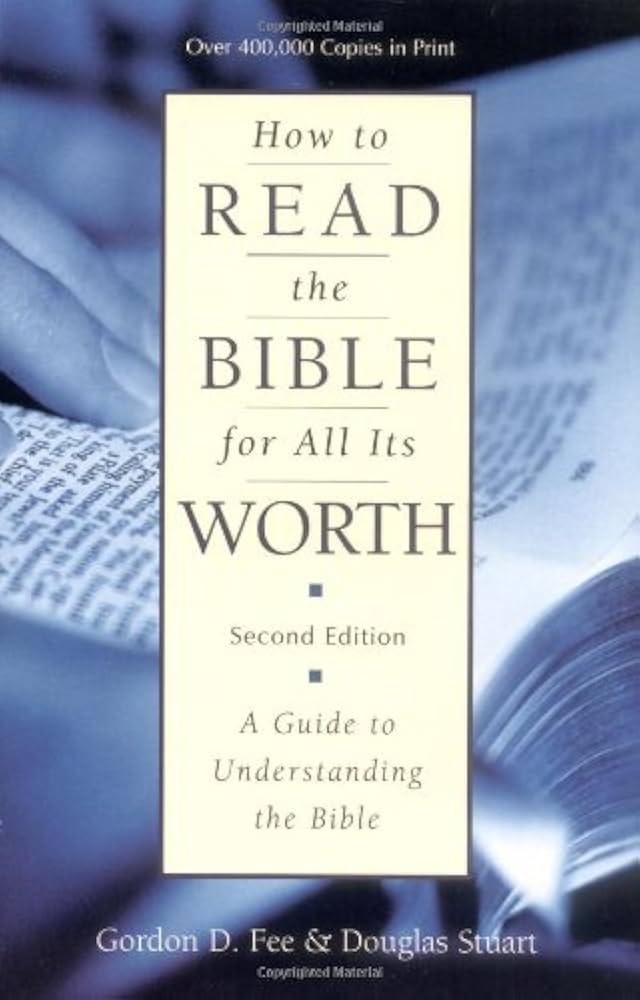
An interesting question along those lines was posed to a number of us today and I realize I have been neglectful in never mentioning this before. Start with this book, “How to Read the Bible for All Its Worth” 

How to Read the Bible for All its Worth was first recommended to me by a Sydney Anglican minister back when I first began to journey with Jesus. It was written by Gordon Fee – a Pentecostal scholar – and Douglas Stuart. That I am STILL recommending it today, as an Emerging Church blogger, when Pentecostals, Sydney Anglicans and Emerging Church leaders agree on so precious little should give you all pause for thought. Why do I recommend it along with these other guys?

Because the book is just so darn good. Having sold over half a million copies it in now into its third print. Its recommended by leaders across the theological spectrum to youth and seminary students and everyone in between because it is both deep and highly accessible. More importantly, it is simply one of the finest introductory books you’ll come across on how to recognize and understand the literary genres within the Bible and read the texts in  context. Quite simply, most bad interpretation arises from inadequate appreciation for the importance of genre and taking texts out of context. How to Read the Bible for All its Worth guides you past the pitfalls towards a more useful and rewarding experience.

Here’s how one reviewer put it:

The authors, one an Old Testament scholar and the other a New Testament scholar, cover issues of translation, the literary genres (epistle, narrative, parable, poetry), and the meaning of the writings for their original audience and their implications for the church throughout its history. They show how proper interpretation requires various methods of exegesis according to the literary type being studied—Gospel, Law, Apocalypse, Wisdom.

How to Read the Bible for All its Worth guides readers toward a better handling of Scripture by teaching them how to avoid misinterpretations through the proper use of context. Throughout the book, the importance of reading a passage holistically, according to the overall content of Scripture, is emphasized.

So whether you’re a new Christian or an experienced Christian, or even a non-Christian want to see just what holds the Bible together, start here.

4 responses to “How to Read the Bible for All its Worth”

  1. Peggy Avatar
    Peggy

    Thanks for this, Matt! I have all three versions of this book, dating back many years. It’s companion book, How to Read the Bible Book by Book is also good (and they have cross-referenced them!) makes them a wonderful set for everyone to have!
    I have terrific memories of a colleague joining me for a 13 week series teaching through the first book. I made up a series of bookmarks about the different genre…have them in my Bible in those very places, so I can always do a reality check when I’m reading there!
    I go back to these two volumes almost weekly. That this book is not a regularly offered study in every church is a mystery to me….
    Thanks, again!

    Like

  2. Kalessin Avatar

    It is a remarkable book. It’s one of those that would make for a fruitful reading group for reasonably thoughtful people of mixed spiritual or anti-spiritual backgrounds; Everyone would take something useful from it.
    I think of it on the same level as —
    Philip Yancey: The Jesus I Never Knew.
    Craig Blomberg: Making Sense of the New Testament.
    C.S. Lewis: The Abolition of Man.
    Bruce Shelley: Church History in Plain Language.
    Except for Shelley, these are all quite short as well. Intersperse ’em with some of the ‘New Atheism’, and you’d have some good discussions. I don’t know of a good general introduction to Theology, though. ‘Mere Christianity’ is getting on a bit, and the old Trilemma’s somewhat rusty, but I think I’d still suggest it for that purpose. Any other suggestions?
    As an aside, I have Fee and Stuart’s “How to Read the Bible Book by Book” (the sequel of sorts) but it’s neither as succinct nor as helpful, though I’m sure it would help newcomers to approach the Old Testament in particular with less of a sense of disorientation.

    Like

  3. Matt Stone Avatar

    This has all got me thinking about what I would recommend as a good introduction to Christianity in general and to be honest I can’t think of one.
    Most of the ones I was introduced to as a new Christian were heavily doctrinal. Not nearly practical enough. Makes me wonder if I should write one.

    Like

  4. Peggy Avatar
    Peggy

    Well, Matt…now you know why so many of us write our own curriculum! When I was the associate pastor in charge of new members, I wrote a five-part series to address this very issue.
    I did find two books by Gilbert Bilezikian that inspired me to write my own (basically contextualizing it for our specific congregation): Christianity 101 (Your Guide to Eight Basic Christian Beliefs) and Community 101 (Reclaiming the Local Church as Community of Oneness). They are both published by Zondervan and should be available on-line…I got mine at a Willow Creek conference. (Dr. B. is one of the founders at Willow and taught at Wheaton for years.)
    More recently, I have enjoyed Neil Cole’s “Cultivating a Life for God” as an approach that I think is helpful. The book is, however, more geared for the leader…so it might give you some ideas, just like it has given me some!
    My work was much more basic and pointed to other books…which may be what you’re looking at, Matt–something that is approachable from a first glance.
    I would like to see what you write…it would certainly be an approach that would be fresh, given your background.
    Go for it!!!

    Like

Leave a reply to Peggy Cancel reply