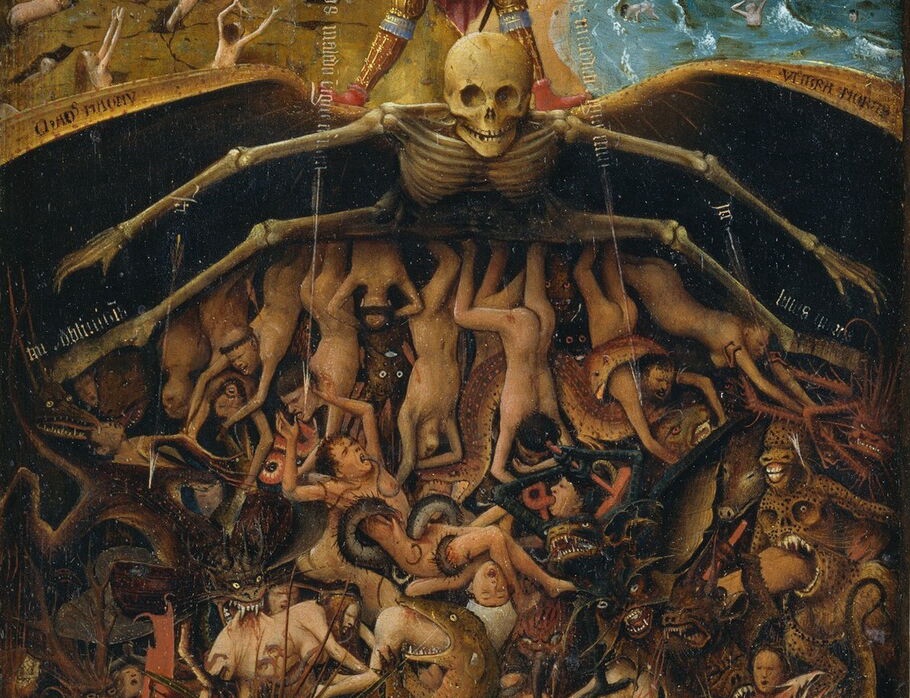
I have been meaning to write something about hell here for a while, with it being such a thorny issue and all, so when the subject came up on the Salem Gathering forum this afternoon I thought I’d cross post some of my thoughts back here. The conversation is still ongoing, so bear in mind this is just a partial picture, but here’s my initial contribution:
The problem with talking about hell is that we have too many preconceptions about it. Over the years we’ve seen so many renaissance paintings, and so many Hollywood fantasies, both horrific and humorous, that it is difficult to read what the Bible has to say about hell without overlaying it with all sorts of imported images from elsewhere.
For example, in the popular imagination hell is often envisaged as an underground lair with steaming lakes of lava, populated by red demons running around with pitchforks taking great glee in tormenting naked men and women with the most exquisite punishments. But virtually none of this is Biblical. Demons never have pitchforks. The Bible never depicts demons as in charge of hell, only as prisoners in it, awaiting final punishment. Satan is described as an angel of light, and as a multi-headed dragon, but never as a sexy thing in red leather or spandex. Hell itself is described variously as a bottomless pit, as a lava lake, and as a rubbish tip, but curiously, caves are never mentioned. The Bible does not present us with one image of hell, it presents us with several, but none of these are what popular culture has told us to expect. What becomes clear from a deeper reading of what Jesus and the prophets actually said is that they were being very poetic when invoking it, and we need to look deeper if we want to understand what it points to.
Nowhere is this problem more obvious than with the word “hell” itself. A forgotten truth here is that the word “hell” is one we Christians adopted from Germanic Pagans. In the original Greek, the apostles spoke of Hades and Tartarus, the lands of death and punishment drawn out of Pagan mythology. Before attacking hell as an abominable Christian construction what needs to be recognized is that much of what we find in the New Testament actually represents a dialogue with Pagan culture using terms drawn out of Pagan culture. Uncovering the real meaning requires us to uncover similar worldview bridges in contemporary terms.
A complicating factor here is perception of time. Buddhists and Hindus have there own hells, but with their cyclical view of time souls are never permanent residents in it. This strikes many contemporary westerners as a good thing. What those same westerners often fail to appreciate though is that Buddhist and Hindu conceptions of heaven are similarly impermanent. Because of this, these systems rapidly shift to judging all existence as hellish, as samsara and maya respectively. To be reincarnated is to be trapped in a living hell. Is this truly more liberated than the Christian view?
The deeper we explore different worldviews, the more obvious it becomes that many of them have hells of sorts, however differently they may be envisaged. What is the common factor? I would say it is the understanding that actions have consequences, either in this life or the next. Only nihilists say otherwise. What distinguishes Christianity, Islam and Judaism from Buddhism, Hinduism and Paganism is that they see history in asymmetric terms rather than symmetric terms, that they see a direction and purpose to history and thus hold out the hope of eternal resolution rather than eternal return.
Worldviews that do not incorporate a hell or judgment day of one sort or another must account for how injustices sometimes never have consequences in this life, how rapists sometimes seem to get away with it, how the poor sometimes suffer for no apparent reason. Generally such worldview systems come up with one of two possible resolutions, either the person deserved their blessings or punishments in some way we are not aware of, or the universe is amoral and indifferent. Both of these ideas have their own consequences.






 Curious Christian
Leave a comment