Curious Christian

Reflections on culture, nature, and spirituality from a Christian perspective

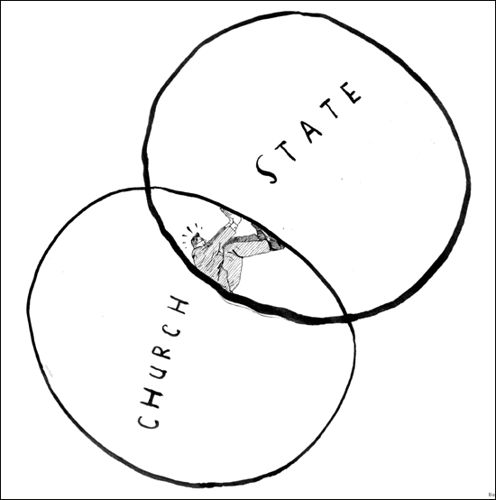
What does the sacred / secular split have to do with the Christian / Atheist debate? How a person answers that question can reveal much about their understanding of pluralism.

For instance, I find it interesting that many Christians still presume a successful debunking of Atheistic reductionism is ipso facto a victory for Christianity. And I find it equally interesting that many Atheists still presume a debunking of six day creationism is ipso facto a victory for Atheism. It shows they are still operating under the mistaken assumption that there are only two sides to these debates.

But in a pluralistic society there are many, and Flying Spaghetti Monsterism, the joke religion invoked by some to prove the point, is only the tip of the iceberg. Other ‘isms’ we have to contend with these days include Hinduism, Buddhism, Islam, Judaism, Paganism, Spiritualism, Consumerism, Relativism, and the list goes on. They all have their own cosmologies, they all have there own takes on how the world works and how it came into existence. In this context, debunking is a futile approach unless you are narrowcasting to one specific ism. When broadcasting across multiple isms it is necessary to build your case on a far more positive platform, if you want to make a broader impact that is.

This become very interesting when you start talking about “transforming secular space” as Ryan Bolger terms it. The one thing you shouldn’t do is assume secular automatically equates to Atheistic. It doesn’t, not anymore. What secular space is these days is an ‘ism’ melting pot.

3 responses to “Rethinking the Christian-Atheist Debate in a Pluralistic Society”

  1. kalessin Avatar

    One day I’m going to finish reading ‘The Secular City’ by Harvey Cox; he argues in what I’ve read thus far that secularity (as opposed to secularization) is a Christian theological commitment. I think he may well be right, at least before Constantine and after Locke on Tolerance and the disestablishment of church from government (you know, in proper Christianity).
    The question I find interesting is what kind of valid taxonomy can be used with the major world faiths. The usual western approach, whether atheistic or otherwise (for disposal or dialogue), has been consistently reductionistic. Kathryn Tanner writes:

    Pluralist generalizations about what all religions have in common conflict with genuine dialogue in that they prejudice its results. Commonalities, which should be established in and through a process of dialogue, are constructed ahead of time to serve as presuppositions of dialogue. [1]

    She’s responding to John Hick in this regard, who has to lop off large parts of Christianity in particular to make it fit a general religious schema.
    So it’s easily observed that there’s more variety than simple reductionism is comfortable with. But there’s not an infinite variety by any means, so categorizations should be possible.
    There’s Atheism and Theism along one axis — and then what? Hinduism can be anything (incl. atheist or theist) depending which part you look at. Polytheism either has a high god or not, thus reducing to one or the other. Pantheism’s top-level entity either has personality or doesn’t, making the same basic categorization possible, and having many of the same philosophical consequences.
    What do you see the major categories being, if only for the modest, practical purpose of gaining a reasonable overview of the options?
    [1] Kathryn Tanner, ‘Respect for Other Religions: A Christian Antidote to Colonialist Discourse,’ Modern Theology 9 (1993), 1-18: p.2; cit. Alister McGrath A Scientific Theology, Vol. 1: Nature (Edinburgh: T & T Clark, 2001).

    Like

  2. Matt Stone Avatar

    Oh goodness, you’re stretching me now, I sketched out a rough taxonomy along these lines years ago; now I am going to have to dig through my archives.

    Like

  3. Matt Stone Avatar

    Nigel, still haven’t found it yet, but I think the reason I abandoned it was precisely because the simpler the system the more reductionist it tended to be. I found that in interfaith dialogue there was simply no substitute to one-on-one listening if you wanted to accurately understand where a person was coming from.
    For example, just take the atheism-theism axis, which has also been variously described as impersonal-personal or mechanistic-organic axis. It could easily be argued that Theravada Buddhism sits on the atheistic end of the spectrum, for the historical Buddha’s teaching about ultimate reality was about as far away from devotional spirituality as you can possibly get. Yet, he never denied the possibility of lesser divinities and spirits. Conversely, when we come to Christianity, although there is very much an emphasis on the personal, we still retain teachings on inorganic forces such as curses and blessings.
    You see, while Buddhism and Christianity may readily be spoken of as sitting on opposite ends of the atheistic-theistic spectrum when we limit the discussions to our concepts of ultimate reality, once you consider our metaphysics holistically this schema rapidly breaks down. Add a few more axis’ and the problem expands exponentially. And this doesn’t even take into account inter-religious diversity.

    Like

Leave a reply to kalessin Cancel reply