Curious Christian

Reflections on culture, nature, and spirituality from a Christian perspective

Enoch

I noticed the book of Enoch was uploaded to the Internet Sacred Texts Archieve a few days ago and is now available for free. Enoch is one of the more interesting apocraphal books in my opinion so if you want to read it click here.

Being a Christian I find Enoch chapter 46 particularly interesting …

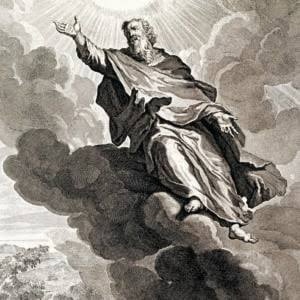
There I beheld the Ancient of Days, whose head was like white wool, and with him another, whose countenance resembled that of man. His countenance was full of grace, like that of one of the holy angels. Then I inquired of one of the angels, who went with me, and who showed me every secret thing, concerning this Son of Man; who he was; whence he was; and why he accompanied the Ancient of Days.

He answered and said to me, “This is the Son of Man, to whom righteousness belongs; with whom righteousness has dwelt; and who will reveal all the treasures of that which is concealed: for the Lord of spirits has chosen him; and his portion has surpassed all before the Lord of spirits in everlasting uprightness.”

… particularly given its close parallel to the Revelation chapter 1

I turned around to see the voice that was speaking to me. And when I turned I saw seven golden lampstands, and among the lampstands was someone “like a son of man,” dressed in a robe reaching down to his feet and with a golden sash around his chest. His head and hair were white like wool, as white as snow, and his eyes were like blazing fire. His feet were like bronze glowing in a furnace, and his voice was like the sound of rushing waters. In his right hand he held seven stars, and out of his mouth came a sharp double-edged sword. His face was like the sun shining in all its brilliance.

When I saw him, I fell at his feet as though dead. Then he placed his right hand on me and said: “Do not be afraid. I am the First and the Last. I am the Living One; I was dead, and behold I am alive for ever and ever! And I hold the keys of death and Hades.

See the parallels? Now what does that suggest to you?

8 responses to “Enoch”

  1. Steve Hayes Avatar

    Some Orthodox Churches have ikons showing Christ with the Ancient of Days, who resembles Christ except for having white hair.

    Like

  2. Matt Stone Avatar

    Steve, you’re giving me ideas for more art.

    Like

  3. Isaiah Avatar
    Isaiah

    Matt, do you believe this book is inspired then, or influencing John when he wrote Revelation?

    Like

  4. Matt Stone Avatar

    I do not consider Enoch to be inspired, but I am open to the suggestion Enoch influenced John, at least indirectly, and possibly even directly, at least in a stylistic sense.
    The Revelation of John may seem to be a rather unique book when compared to other books of the Bible, but it is not quite so unique when compared with a wider selection of ancient Jewish literature. Both Enoch and John belong to the genre of ‘apocalyptic’, a genre which is noted for its poetic imagery and messianic expectations.
    Why I raise it is that, as with Gordon Fee in his book “How to Read the Bible for All Its Worth” I believe it is very important to understand the genre of a book if you want to interpret it accurately. With the book of Revelation, that means, to a certain extent, going beyond the Bible and familiarizing yourself with other examples of apocalyptic literature. The reason this is important is, the more you become familiar with the similarities, the more sensitive you become to the genuine dissimilarities, those ways in which the Revelation of John is truly unique and not just superficially so.
    With the above example, it becomes clear that the early Christians were not the only Jewish sect to draw on “Ancient of Days” and “Son of Man” language and imagined throne scenes. But observe how the Revelation of John blurs the distinction between the white haired Ancient of Days and the Son of Man in a way that Enoch does not. And think about what that implies theologically.

    Like

  5. Isaiah Avatar
    Isaiah

    What do you think about the book of Jude, which quotes Enoch directly?

    Like

  6. Kalessin Avatar

    Commonly the way in which the NT references its sources tells you more about its meaning than the statements themselves. Try tracking down the OT references behind the “living water” in John 7, and seeing what it signals to an Septuagint-savvy reader, and you’ll see what I mean.
    Scholarship has come a long way in this respect in the past few years. Craig S. Keener’s 2003 commentary on John, for example, has an Ancient Sources index of about 200 pages. The increased depth that this kind of literary and social-historical study has brought to the NT has made the past 30 years, to my mind, the most exciting period in the whole history of theology — since the 2nd century, at least.

    Like

  7. Matt Stone Avatar

    Beyond Jude quoting Enoch there is also Paul quoting Pagan poets in Acts 17 and Psalms adapting the Egyptian Book of the Dead. I agree with Nigel, “the way in which the NT references its sources tells you more about its meaning than the statements themselves.” I might refer to it as cultural-linguistic jujitsu.

    Like

  8. Steve Avatar

    I noticed on following the link it wasn’t free.

    An interesting commentary on the reception of the Book of Enoch among Jews and Christians here Angels and demons and egregores (book review) | Khanya

    Like

Leave a reply to Steve Hayes Cancel reply