Curious Christian

Reflections on culture, nature, and spirituality from a Christian perspective

The politics of Christian art

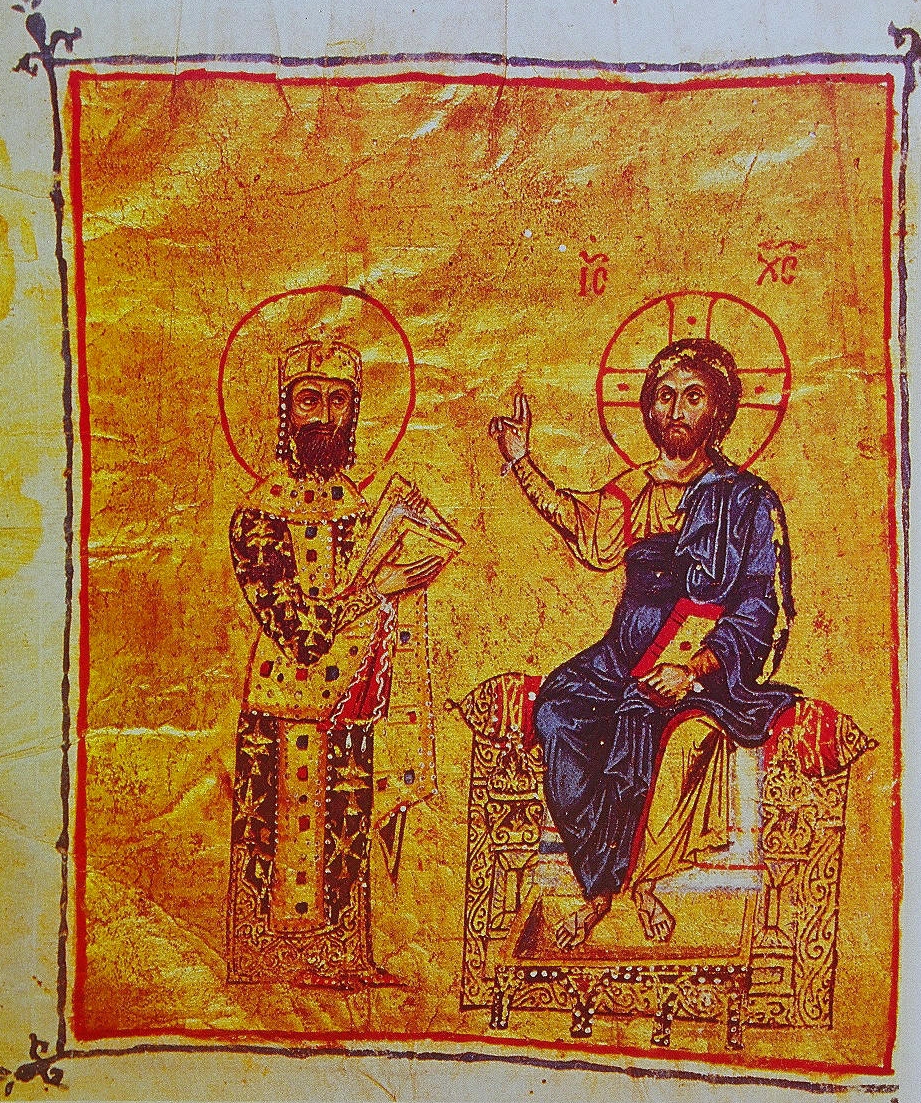
Alexios1komnenos
Just as we need to deconstruct texts, we also need to deconstruct images.

This image features Emperor Alexius I Comnenus before Christ. Jesus is seated on the throne (indicating his lordship over the Emperor) with his right hand in a benediction gesture (indicating his blessing on the Emperor). The Emperor himself is illuminated by a halo, indicating holiness.

The question that arises for me is, what is the impact this would have had on the audience for which it was originally intended? What is it saying theologically and politically?

7 responses to “The politics of Christian art”

  1. Arthurandtamie.wordpress.com Avatar

    The two-figure gesture is an interesting one. Originally it wasn’t about blessing but the gesture of the orator. So it’s in all the early Pantonkrator images: “Listen to me, people!” I think by the time of this emperor it had changed meaning…
    Arthur

    Like

  2. Arthurandtamie.wordpress.com Avatar

    Whoops, Pantokrator
    …ie, the gesture is a mark of Jesus’ authority rather than blessing.

    Like

  3. Steve Hayes Avatar

    The blessing is also one given by priests, in which the fingers are placed to represent the letters IC XC, i.e. “Jesus Christ”.
    As for the ikon, what it is saying theologically and politically is that political power and authority are to be exercised subject to Christ, and not sought for their own sake. The task of those in authority is to make the earthly kingdom an image of the heavenly one in righteousness and justice.
    Because of human sinfulness they don’t often succeed, and never succeed fully. Even the best human rulers are often vilified. And even those with the best intentions are often unable to achieve them, and are trapped in the system. I think one of the best examples in recent times was US President Jimmy Carter, who, I think, saw his task as the kind of stewardship role portrayed by the ikon. I believe he genuinely tried to seek first the kingdom of God and its righteousness, and was rejected by the people who thought the US president should seek first the American “national interest”, righteous or not.

    Like

  4. John Avatar
    John

    At the level of worldly power power such art was used to legitimate the “divine right” of kings, and to simultaneously mystify the masses.

    Like

  5. Steve Hayes Avatar

    “Divine right of kings”?
    No, that’s an anachronism, and is about 1000 years out. The theory of the divine right of kings was developed in early modern Europe, especially in the West, and specifically in France, at the time of the rise of the modern nation state, and was part of the process of Western secularisation.

    Like

  6. Matt Stone Avatar

    Nevertheless there does seem to be some sort of symbolic legitimation going on there. Imagine this as an alternative: Christ getting down from the throne and washing the feat of a peasant and an empiror, enjoining them both to do likewise.

    Like

  7. Steve Hayes Avatar

    Oh yes, there is some sort of symbolic legitimation going on there, as in Dan 4:25 – the most High rules over the kingdom of men, and gives it to whom he pleases. See also Ps 82.

    Like

Leave a comment