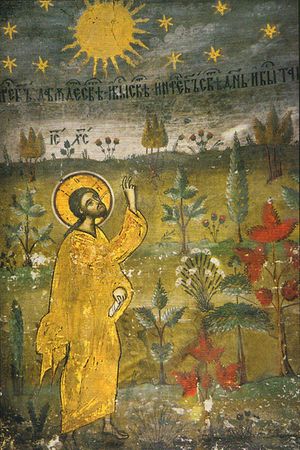
I’d like to share a few thoughts for discussion. If we take inspiration from the Apostle Paul’s example in Athens and elsewhere, we should emphasize cosmic Christology over ecclesiastical Christology when explaining our faith to Pagans. This means focusing on the resurrection’s implications for all of creation, not just the covenant community. In simpler terms, we need to highlight how Jesus holds significance not only for everyone but for everything.
A key aspect of this is Paul’s frequent use of the terms panta and panton in passages rich with cosmic Christology and its related concept of Christological cosmology. For instance:
- In Hebrews 1:1-3, we read that God has spoken through His Son, whom He appointed heir of all things (panton), and through whom He created the universe. The Son is described as the radiance of God’s glory, sustaining all things (panta) by His powerful word.
- Colossians 1:15-17 states that the Son is the image of the invisible God, the firstborn over all creation. In Him, all things (panta) were created—things in heaven and on earth, visible and invisible. He is before all things (panton), and in Him, all things (panta) hold together.
- Ephesians 4:10 tells us that the one who descended is the same who ascended higher than all (panton) the heavens to fill the whole universe (panta).
- Acts 17:24 reminds us that the God who made the world and everything in it is the Lord of heaven and earth, not confined to temples built by human hands.
These passages resonate with Jesus’ declarations about all things (panta) being entrusted to Him (Matthew 11:27) and restored (Matthew 17:11). In summary, our theological reflections should begin with the understanding that Jesus’ significance extends far beyond the social realm to encompass everything: the sea, the sky, the earth, and all that is within them.
One of my favorite images is from Revelation 4 and 5, where the Lamb of God is surrounded not only by the twenty-four elders (representing the covenant people) but also by the four living creatures, symbolizing creation itself engaged in worship.
Visually, a common theme in Eastern Orthodox iconography is Christ Pantocrator, meaning “all-powerful.” This raises important questions about what we, as Christians, mean by power. The Lamb, referred to as a lion, offers a clue: this understanding of power is counter-cultural. It is a power rooted in giving rather than taking, in the cross rather than the sword. This is the message we need to share with the Pagan community—the good news of Jesus as the magic of the Messiah.



 Curious Christian
Leave a comment