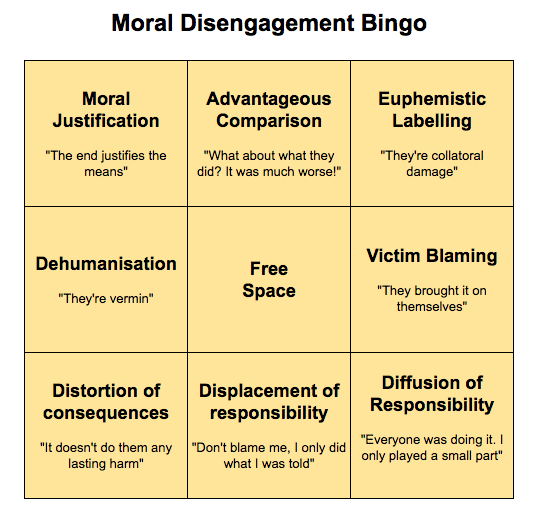
I am finding Albert Bandura has a very useful model for identifying the mechanisms of moral disengagement. Indeed, when I consider the current crisis of refugee children being removed from their parents, I can say I’ve seen plenty of examples of all four major mechanisms and their subtypes coming into play already. The following examples have come from multiple sources:
- Behaviour reframing
- Moral, social, and economic justifications. “They’re an existential threat”
- Euphemistic re-labelling. “They’re not asylum seekers, they’re illegal immigrants”
- Advantageous comparisons. “Lesser of two evils. A strong deterrent saves more people in the long run”
- Consequence reframing
- Denial of the consequences. “They are being treated well”
- Misrepresenting the consequences “It’s actually good for them”
- Responsibility reframing
- Deflecting the responsibility. “It’s the Democrats law”
- Diffusion of responsibility. “It’s not like it’s me who’s mistreating them”
- Victim reframing
- Dehumanisation. “They’re animals”
- Blaming the victim. “Their parents are responsible for bringing them”
Have you seen any of these mechanisms in play?








 Curious Christian
Leave a comment