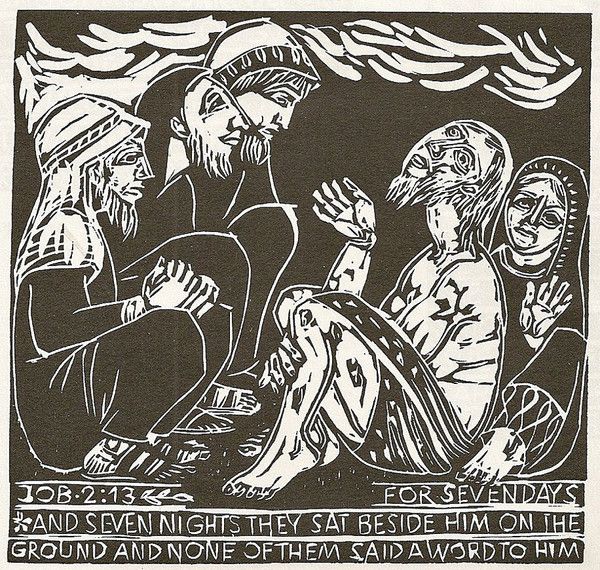
One aspect of the story of Job which seems under explored to me is the fact he was non-Israelite. Job came from the land of Uz, outside the covenant people, with no mention of Torah, Temple, priesthood, or promised land. Yet God says of him, “There is none like him on the earth, a blameless and upright man, who fears God and turns away from evil” (Job 1:8). If Lamentations 4:21 is correct in associating Uz with Edom, the challenge becomes even more pointed: one of the holiest men in Israel’s Scriptures may have come from a people remembered as descendants of Esau and longstanding rivals of Israel.
This is not an isolated provocation. Again and again, Scripture places outsiders at the centre of God’s purposes. Melchizedek blesses Abraham. Jethro, the Midianite, offers wisdom to Moses. Ruth the Moabite becomes the great-grandmother of David. Naaman the Syrian confesses the God of Israel, while Jesus later makes a Samaritan the model of neighbourly love. The biblical story consistently refuses to allow God’s favour to be captured by blood, tribe, or nation.
Indeed, the prophets themselves unsettle any tribal reading of Israel’s vocation. Through Amos, God asks, “Did I not bring Israel up from the land of Egypt, and the Philistines from Caphtor and the Syrians from Kir?” (Amos 9:7). Israel’s exodus remains unique in its purpose, yet the God of Israel is never merely Israel’s God. He is Lord of history itself, moving nations according to his purposes and caring for peoples beyond the boundaries of the covenant community.
Perhaps this is why racism and ethnocentrism are ultimately forms of idolatry. They seek in ancestry, culture, or nation what belongs to God alone. They assume that righteousness naturally resides among “our people” and that the outsider stands further from divine favour. Yet the opening of Job shatters that illusion. Before Israel’s kings, before its prophets, before its temple, God points to a man from Uz and declares, “There is none like him on the earth.”
If God could say that of a man who may even have belonged to Israel’s ancestral enemies, what assumptions about our own tribes, cultures, nations, and opponents still need to die?




 Curious Christian
Leave a comment