Curious Christian

Reflections on culture, nature, and spirituality from a Christian perspective

Can you be too incarnational?

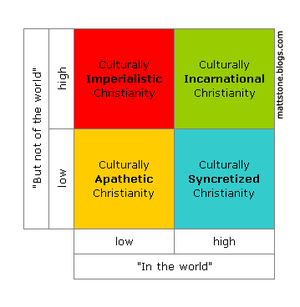
Since Alan Hirsch has goaded me during a discussion I thought I would publish a diagram I have been working on in an effort to try and articulate my own position. In essence my answer is no, you can never be too incarnational, for properly understood that’s akin to asking whether you can be too Christlike.
incarnational-christianityWhat do I base this on? Towards the end of the Gospel of John, Jesus prays “I have given them your word and the world has hated them, for they are not of the world any more than I am of the world. My prayer is not that you take them out of the world but that you protect them from the evil one.”

In others words, Jesus calls us to move within this world without being of this world, to engage with our culture and his teachings simultaneously, without distancing ourselves from either. If  Jesus is truly our axis mundi, the centre of our world and our way, then we will live like him and challenge cultures where they needs to be challenged from within.

But often that’s not what we find. Often what happens instead is we find Christians either isolating themselves from host cultures (the imperialist-fundamentalist approach) or capitulating to host cultures (the syncretist-liberal approach). Both ways lead to blunted witness. Sadly an even worse option is even more common, that of being “of the world but not in the world,” whereby Christian compromise with culture and gloss it over with layers of churchianity that effectively cuts of further cultural engagement.

Now this is all very technical stuff, what does it look like in practice?

In most missional literature the examples you’ll find tend to focus on incarnational Christianity for people with Muslim or Jewish backgrounds. That’s all very well and good, but I don’t find myself amongst monotheists so often. Not my scene. More often I find myself amongst pantheists and polytheists, that is, amongst New Age “whateverists,” western Buddhists, yoga practitioners, NeoPagans, witches and goddess worshippers. What does incarnational Christianity look like in that sort of context?

Maybe its easier to start off with what incarnational Christianity does not look like! It does not look business is usual. No, its culturally imperialistic to foist megachurch Christianity on esoteric background people, and “gentile circumcision” like this ultimately compromises the gospel. Neither does it look like the various varieties of Christopaganism and Zen Christianity that many church-burnt individuals experiment with. No, Christ is not one guru or god or ascended master amongst many for the genuine Christian. And neither does it look like prosperity theology or strategic level spiritual warfare or various other varieties of baptized animism. No, incarnational Christianity is a different animal altogether.

So, how would a pagan-sensitive Christianity differ from Christopaganism? Just how different is the incarnational approach from the syncretistic approach in this sort of context? Like the Christopagan, the pagan-sensitive Christian is unafraid to use and, where necessary, reframe  esoteric langauge and symbols and customs to aid communication (and unwary visitors to this site sometimes mistake me for a Christopagan on that basis). The proviso for the incarnational / pagan-sensitive Christian is that Christ motivates everything behind this, and is the measure of all that transpires. For the incarnational Christian, Christ is God in the fullest meaning of the word.

36 responses to “Can you be too incarnational?”

  1. alan hirsch Avatar

    Matt, very useful. And on the whole I am fully with you. Can I ask, are you actually using syncretism in a positive way here? Normally is is considered as a negative. A bleding of religions (as in Christopaganism) not a genuine Christianizing of them.

    Like

  2. alan hirsch Avatar

    Sorry, I looked at the diagram again and I noticed I had misread it. We are totally in league.

    Like

  3. Peggy Avatar
    Peggy

    Thank you for stepping up to the challenge, Matt. I so appreciate you and your willingness to help us get farther down the road….

    Like

  4. Isaiah Avatar
    Isaiah

    I finally have wrapped my head around this missional-incarnational thing and how it relates to the new testament church. You used the phrase “gentile circumcision”. My knowledge of biblical new testament background and my grasp on the missional-incarnational impulsive have finally been linked together. Thanks.

    Like

  5. Matt Stone Avatar

    Alan, I appreciate your question. Behind the scenes some of our group have wondered if, since “contextualization” is strange language for many people, whether we could alternatively speak in terms of “good syncretism” and “poor syncretism” where it suits the crowd (note: Sun Warrior, you are probably one of the people I have in mind here since your take on some of these words is very different to evangelicals). I still have to be won over but am prepared to explore it. In terms of the diagram though, only the nameswould change, not the essential thrust of it.

    Like

  6. Matt Stone Avatar

    Peggy and Isaiah, glad you have found this of value. You may be interested to know that I actually wrote an article on contemporary “gentile circumcision” for Zadoc Perspectives last year when they did an expose on the emerging church.

    Like

  7. Matt Stone Avatar

    I should add, after I wrote this it occured to me I could have alternatively labelled the vertical axis “transformative potential” and the horizontal axis “cultural proximity” but I think I leave it as it stands with this explanetory note.
    The problem with the imperialistic-extractional approach is not that it lacks transformative potential, its that it misdirects the transformative challenge. It not only challenges people with the gospel but also with an alternate culture, thus requiring a double conversion of sorts. This is where the “gentile circumcicision” analogy comes in. In the New Testament some Christians were insisting that turning to Christ require gentiles to adopt Jewish cultural practices such as circumcision and kosher food laws. Paul told them off in no uncertain terms. No, we are to learn to be Christians in whatever culture we find ourselves in.
    Conversely, the problem with syncretism is not that it is so culturally engaged, its just that it waters down the challenge of Jesus to the point it lacks transformative potential.

    Like

  8. Steve Hayes Avatar

    “Transformative potential” and “cultural proximity” are far to vague and abstract to have much meaning. If you had used them my eyes would have glazed over and skipped your diagram. As it is, I’ve bloggad about it and linked to it, though I don’t think Typepad trackbacks work too well in other platforms. If it doesn’t, you can find my contribution here.
    Yes, “contextualisation” is a horrible piece of missiological jargon. I remember a friend who was teaching English to seminarians threatening to take examples of bad English and poor communication from things the lecturers said, and one she pounced on was when one of the lecturers said “We must be context centred”. As she pointed out to the students, the context is what comes before and after, so “context-centred” is quite meaningless.
    Another friend and I wrote a parody of this kind of thing in a newsletter, in an article called Towards a circumference-centred theology. But you can’t take the Mickey, and within a year some theologian (in Japan, I think) was putting it forward quite seriously.

    Like

  9. nic paton Avatar

    Matt, I like the schema a lot.
    Green, despite its overuse as eco-cliche, says sustainablity, life, earthiness. I can see blue representing the “too heavenly minded”. I am not quite as clear about orange and yellow.
    I think consideration for design and meaning is important. I am currently working on worship projects with more image and less word, so my media and languages are shifting, too.
    I’ve been wrestling with the idea of the narrow road, too… For me its not about an abstaining, closed-out lifestyle, but about a balance between extremes, such as being too world-centric or too heaven-centric. What is your take on this? More troublingly, how does “breadth” (the broad way) lead to destruction?

    Like

  10. Matt Stone Avatar

    LOL, I’m glad I went with my first instincts then and didn’t reword it! The main reason I had held off posting this till the right conversation came up was uncertainty with the phrasing. Still not entirely satisfied with it as you see. But if it helps a few people despite it still being a bit rough that’s cool. I hope reader reactions can help me fine tune it.

    Like

  11. Nathan Hale Avatar

    Great post here. That diagram is very effective in illustrating the point.

    Like

  12. sally Avatar

    Matt this is excellent- may I use your diagram, I have a teaching day coming up on incarnational mission and this makes things so clear…
    btw I too have been labeled a Christopagan by some folks- others simply acuse my of syncretism… the price of being incarnational I guess…

    Like

  13. Matt Stone Avatar

    Sure Sally. I am happy for people to use any of my stuff for non-profit purposes provided there’s some form of acknowledgement as to where it came from. I suppose I should put a general policy type comment up somewhere.

    Like

  14. Peggy Avatar
    Peggy

    I am looking forward to your descriptions of each of the quadrants, Matt. Something that compares and contrasts them to each other. Got something in the works?

    Like

  15. Lorna (see-through faith) Avatar

    Sally sent me your way. Interesting thoughts here … especially “gentile circumcision” – haven’t heard that expression before but it really helped me in getting my mind round this.

    Like

  16. nic paton Avatar

    I’ve taken to this like a Rubik cube newbie.
    Matrices like this are helpful; I had a conversation with someone a while back and whenever I mentioned anything outside the orthodox mindset, such as how well One Giant Leap had portrayed the dignity of Death in India, I got the furrowed brow of concern; the implied meaning of which was “This is sychretism, brother”.
    Had I been able to whip out my multicoloured MattStone.blogs.com (TM) diagram there and then I would of at least offered him some possibility of it not being simply that.
    Obsessively speaking now, I think the word which could change in your diagram is “Inverted” – it’s a little too generic/bland. Any suggestions?
    So not to take away from what you have done, Matt, but rather to let the conversation flow, I have tried to give the quadrant some new angles.
    For example
    Creation+ Creator+ : present and Godward = incarnational
    Creation- Creator+ : absent but Godward = pietistic
    Creation+ Creator- : present but Selfward = humanist
    Creation- Creator- : absent and Selfward = just sad (This quadrant is hard)
    Or
    In the world (location) dualistic incarnational
    Of the world (values) materialistic spiritual
    For what its worth …

    Like

  17. brad brisco Avatar

    Glad I found your site, very helpful post.

    Like

  18. sally Avatar

    Oh you’ll have to produce more now Matt!!!

    Like

  19. Matt Stone Avatar

    Yes I know. Have a 2 year old squirming on my back right now though as I type with my laptop on the floor so I’ll have to come back to it 🙂

    Like

  20. Matt Stone Avatar

    Sorry for the delays in responding everyone, I’ve been busy.
    Nic, you asked what my take was on balancing between extremes? It’s core to my entire theology. I developed an appreciation for paradox from Zen and many of my following Christian struggles were centered on paradoxes and imbalances in contemporary Christian theology. With that in mind I draw attention to one of the many passages from scripture focused on opposites in tension: “So be careful to do what the LORD your God has commanded you; do not turn aside to the right or to the left.” (Deut 5:32)
    Peggy, you asked for more detailed descriptions of the quadrants. I have been working on something slightly different which I hope will nevertheless serve the purposes of illustration. I’ll be showing how this relates to Missional pneumatology. Watch this space.
    Nic (again), I am thinking of renaming the bottom left quadrant to “culturally apathetic Christianity”. It represents the sort of Christianity that is narcissistically focused on things like flower rosters and seating arrangements. Not only is it not engaged with culture, it is not focused on anything of any real importance. Totally unmissional.

    Like

  21. nic paton Avatar

    “Culturally Apathetic” – by Jove and by Jupiter, I think he’s got it.
    Bzzzt – cha-chang: RATIFIED.
    BTW as a great example of Imperialitic Thinking, see recent reponses by “Evangelist” to my post on Carlton Pearson http://soundandsilence.wordpress.com/2007/06/21/the-scandal-of-bishop-carlton-pearson/

    Like

  22. Matt Stone Avatar

    With that seal of approval I have updated the diagram with the semantic adjustments and a colour scheme change. Incidentally, I was thinking you could just as easy cast this as an exploration of the tensions between truth and love in Christian theology, truth being the vertical axis, love being the horizontal.
    A word of caution though, this diagram is only intended to illustrate “tendencies”. It is not intended to lock people away in a box. I think communities and individuals can skip through different quadrants on different issues. Nothing says we are at all self consistent at all times.

    Like

  23. nic paton Avatar

    But I WANT to be locked in a box. I want to be consistant at ALL times. It’s too scary hovering about in tendancies and different quadbikes. Matt, I’m begging you, please lock me in a box, maybe that blue one?

    Like

  24. Matt Stone Avatar

    Thou shalt be consistent! There, does that feel better? Did it work? Hmmm, maybe I should start selling jumpsuits to go with it so we can at least look all self-consistent.

    Like

  25. Peggy Avatar
    Peggy

    Thanks for the update, Matt…and the other article, too.

    Like

  26. nic paton Avatar

    OK I swear this is my last word on the colours, but shouldn’t you swap the blue (for Heavenly minded) and the red (for Engaged); the synchretic should be represented by Earthy colours. I’m done. zzzzip.

    Like

  27. Matt Stone Avatar

    I considered it, and I know what you’re getting at, but red is strongly associated with anger, fire and zeal and blue is also associated with calm, water and universality. In the end that spoke more clearly to me. Also, when you bring American red state / blue state politics into the equation there is a correspondance of sorts.

    Like

  28. nic paton Avatar

    Matt
    All hail to your design nous.
    I have taken this discussion in a slightly different but related direction on my new post concerning Incarnation, Inclusion and Hell; it may be of interest to you: http://soundandsilence.wordpress.com/2007/07/12/incarnation-inclusion-and-hell-part-1-a-question/

    Like

  29. hamo Avatar

    I am using the diagram this weekend at our Forge intensiveand I actually modified it a little also 🙂

    Like

  30. Matt Stone Avatar

    No worries mate. Hey, let me know how it goes. I would be interested in the feedback.
    By the way, I was thinking of doing two related diagrams illustrating the difference between the “post-evangelical” conversation, which would feature a whole bunch of arrows flowing out in different directions from the red quadrant, and the “pro-missional” conversation, which would feature a whole bunch of arrows flowing in from different directions into the green quadrant, the aim being to help explain some of the diversity in the emerging church movement.
    It would make clear that while the two conversations overlap for people moving from red to green, the same cannot be said so clearly for others within the emerging church movement. Personally I see my own journey more as a shift from blue to green. And I have come across many post-evangelicals on journeys better characterized as shifts from red to blue or yellow. The irony for me is I am shifting out of blue which others are shifting into it and we are still all calling it the same thing. No wonder a singular definition of these new kinds of Christianity seem so elusive.

    Like

  31. hamo Avatar

    Hmmm… hadn’t considered the journeys we make within, but I want to prompt some discussion on this tomorrow so we’ll see where it goes

    Like

  32. Matt Stone Avatar

    Ah well, journeys in between is what this site is all about 🙂

    Like

  33. Dave Avatar

    Matt: Thank you for this (and for the ongoing discussion). Very helpful and encouraging to see people thinking through these issues.
    I sat and watched Christian TV one night until I couldn’t stand it anymore,turned it off, sat there for awhile and thought, “Most of what we do in Christianity is culturally irrelevant, socially insignificant and evangelistically impotent”. Other than that, it’s all good!
    – From a missional church planter on the Gold Coast

    Like

  34. Matt Stone Avatar

    He he, yeah. How long did it take you till you couldn’t stand it anymore? My personal best is about 2 minutes. Glad you found this of more value that the rest 🙂

    Like

  35. Brett Avatar

    Matt, Thanks, your diagram is very helpful in seeing what your on about.
    On the Question of ‘Can you be too incarnational?’ I am wondering if you can clarify it for me. I see the incarnation as something that has traditionally been reserved for Christ. It seems a stretch to me to see anyone as emulating God becoming man. Could we ever get to the point in our thinking where we see our mission as us ‘being Christ’ for others, rather than as his ambassadors?

    Like

  36. Janet Avatar

    Love it… thanks Matt.

    Like

Leave a reply to alan hirsch Cancel reply