Since Alan Hirsch has goaded me during a discussion I thought I would publish a diagram I have been working on in an effort to try and articulate my own position. In essence my answer is no, you can never be too incarnational, for properly understood that’s akin to asking whether you can be too Christlike.
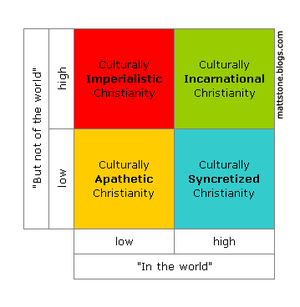 What do I base this on? Towards the end of the Gospel of John, Jesus prays “I have given them your word and the world has hated them, for they are not of the world any more than I am of the world. My prayer is not that you take them out of the world but that you protect them from the evil one.”
In others words, Jesus calls us to move within this world without being of this world, to engage with our culture and his teachings simultaneously, without distancing ourselves from either. If Jesus is truly our axis mundi, the centre of our world and our way, then we will live like him and challenge cultures where they needs to be challenged from within.
But often that’s not what we find. Often what happens instead is we find Christians either isolating themselves from host cultures (the imperialist-fundamentalist approach) or capitulating to host cultures (the syncretist-liberal approach). Both ways lead to blunted witness. Sadly an even worse option is even more common, that of being “of the world but not in the world,” whereby Christian compromise with culture and gloss it over with layers of churchianity that effectively cuts of further cultural engagement.
Now this is all very technical stuff, what does it look like in practice?
In most missional literature the examples you’ll find tend to focus on incarnational Christianity for people with Muslim or Jewish backgrounds. That’s all very well and good, but I don’t find myself amongst monotheists so often. Not my scene. More often I find myself amongst pantheists and polytheists, that is, amongst New Age “whateverists,” western Buddhists, yoga practitioners, NeoPagans, witches and goddess worshippers. What does incarnational Christianity look like in that sort of context?
Maybe its easier to start off with what incarnational Christianity does not look like! It does not look business is usual. No, its culturally imperialistic to foist megachurch Christianity on esoteric background people, and “gentile circumcision” like this ultimately compromises the gospel. Neither does it look like the various varieties of Christopaganism and Zen Christianity that many church-burnt individuals experiment with. No, Christ is not one guru or god or ascended master amongst many for the genuine Christian. And neither does it look like prosperity theology or strategic level spiritual warfare or various other varieties of baptized animism. No, incarnational Christianity is a different animal altogether.
So, how would a pagan-sensitive Christianity differ from Christopaganism? Just how different is the incarnational approach from the syncretistic approach in this sort of context? Like the Christopagan, the pagan-sensitive Christian is unafraid to use and, where necessary, reframe esoteric langauge and symbols and customs to aid communication (and unwary visitors to this site sometimes mistake me for a Christopagan on that basis). The proviso for the incarnational / pagan-sensitive Christian is that Christ motivates everything behind this, and is the measure of all that transpires. For the incarnational Christian, Christ is God in the fullest meaning of the word.







 Curious Christian
Leave a reply to hamo Cancel reply