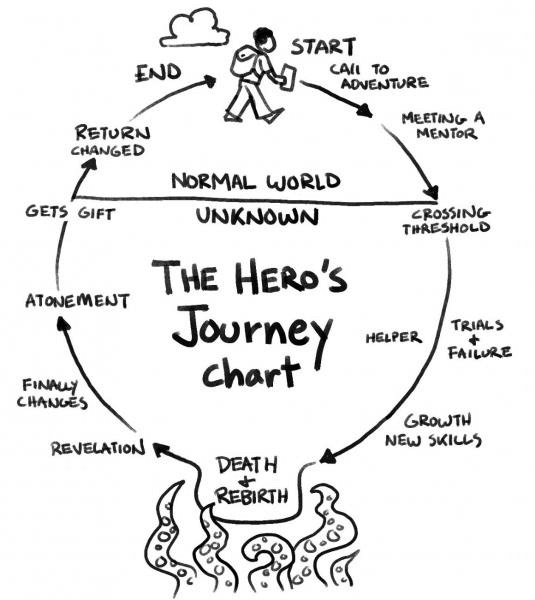
Why is Joseph Campbell important? For those of you not familiar with him, Joseph Campbell was an American mythology professor, writer, and speaker, best known for his book, The Hero with a Thousand Faces. The journey of the hero, what he called the monomyth, figured prominently in Campbell’s comparative studies, and his writings on the hero’s journey have influenced such films as The Matrix and Star Wars. He has also, as a populariser of Carl Jung, exerted a noteworthy influence on popular spirituality, particularly with the Pagan and Gnostic revivals.
Heroes were important to Campbell because, to him, they conveyed universal truths about our own journeys of self-discovery and the means through which societies are renewed.
The personal side. My own interest in Joseph Campbell took off a number of years ago through conversations with Pagan friends who were heavily influenced by him. Indeed I was invited to a Joseph Campbell study group one evening. It dove tailed with my previous interests in Jung, the collective consciousness, alternative spirituality, liminal ritual and the films mentioned above. It also presented me with interesting apologetic challenges, for the story of Jesus was very much interpreted by Campbell through a monomythic lens. In essence, for him, all religions are just masks which obscure the transcendent realities behind myth.
Christian considerations. I have found it interesting, therefore, to explore how Campbell’s thinking squares with the thinking of two Christian mythologists that I am sure you are familiar with, C S Lewis and J R R Tolkien. Drew Trotter writes:
C. S. Lewis’s view of myth and its relation to his stories is complex, and would find some agreement with Campbell’s, but fundamentally he disagrees on a number of crucial points … Eventually, Lewis came to believe in a Christianity that held onto both myth and history and incorporated them both into a belief that Christianity is a myth, but more than a myth because it actually tells of real history and a God who, in space and time, became Incarnate, a word so important to him, he almost always capitalises it.
For more on this see my previous post on Inklings on Myth.
As you might imagine, my thinking is more in line with the Inklings, both in terms of having some fundamental disagreements with Campbell, yet still agreeing in many other ways.
But, despite some criticisms, I believe Campbell has some important insights for us on the power of story, on journeys into liminality, and what this means for the study of spirituality and society. He has particularly influenced how I view and craft alternative worship – in that I consider story far more important than style. And, as you may gather from the name of this blog, I very much see incarnational living as a journey of self discovery and social renewal as well.



 Curious Christian
Leave a reply to Isaiah Cancel reply