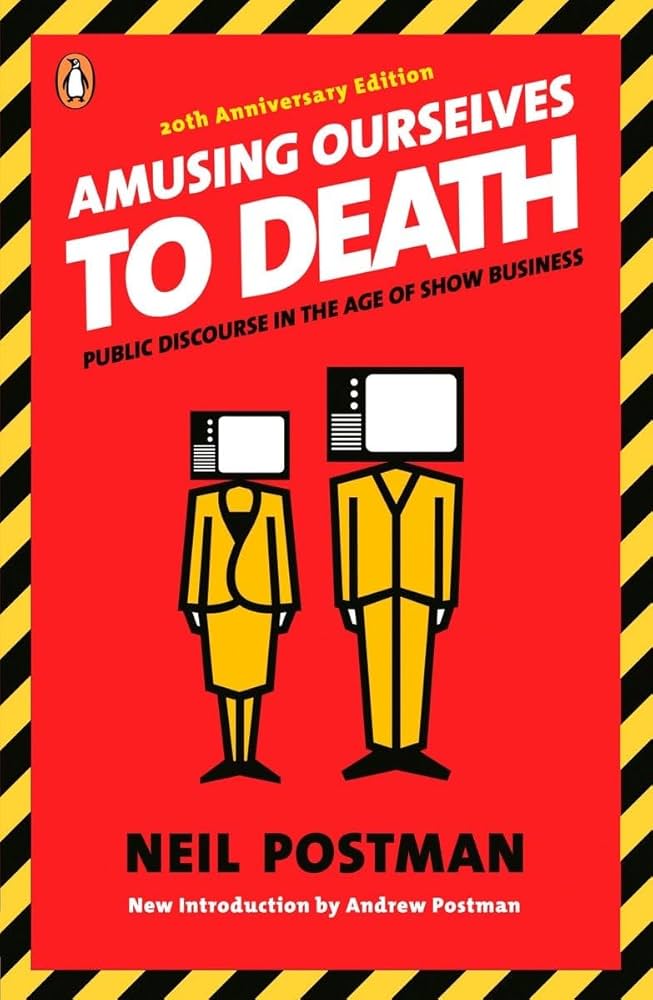
I’ve been meaning to write on this for a while. If you haven’t read Neil Postman’s Amusing Ourselves to Death, you should. It’s full of insight. His reflections on how media shapes our thinking are profound, even though he wrote them over twenty years ago. I wanted to share a few quotes that made me pause and reconsider how deeply our ways of knowing and being are influenced by the technologies we consume.
On Epistemology and Media
Postman makes a simple but profound observation: “Every epistemology is the epistemology of a stage of media development.” In other words, the way we understand truth and knowledge is tied directly to the media we use. What does that mean for us today, in an age dominated by digital screens and algorithms? How do these tools shape our sense of reality?
On the Telegraph
Postman sees the telegraph as a turning point, not necessarily for the better. “The principal legacy of the telegraph,” he writes, “was to dignify irrelevance and amplify impotence.” It brought an overload of information, much of it irrelevant and unactionable, leaving us with less clarity, not more. That rings true today, doesn’t it? We’re flooded with data, but how much of it really helps us live better or more meaningful lives?
He also notes that while burning books is seen as barbaric, telegraphy subtly demands that we burn its contents by undermining coherence and continuity. It made the world seem “unmanageable, even undecipherable.” This sense of confusion feels eerily familiar in our modern age of endless news and constant updates.
On Photography
Photography, for Postman, presents another challenge to how we understand the world. He points out that while a photograph offers powerful testimony, it doesn’t provide “opinions” or context. It’s a world of facts without deeper meaning. “There is no beginning, middle, or end,” he says, in a world of images; just isolated moments, disconnected from any larger narrative. Isn’t that how we often experience life now? Snapshots of reality without the story that gives them meaning.
On Television
Television, for Postman, is the central force shaping modern culture. He argues that, “Television is our culture’s principal mode of knowing about itself.” But what kind of knowing does it offer? Instead of exchanging ideas, he says, “they exchange images.” The result is a shallow engagement with the world, where we’ve become “amused into indifference.”
He also offers a critique of how television presents religion, saying that it “makes authentic religious experience impossible.” The medium itself, with its bias toward entertainment, strips sacredness away, leaving only spectacle. This has profound implications for how we approach spirituality in a media-saturated world.
Entertainment vs. Enchantment
Postman makes a clear distinction between entertainment and true spiritual engagement. “Enchantment,” he writes, “is the means through which we may gain access to sacredness. Entertainment is the means through which we distance ourselves from it.” That struck me. How often do we mistake distraction for depth, amusement for meaning?
He warns, referencing Huxley, that in the age of advanced technology, “spiritual devastation is more likely to come from an enemy with a smiling face than from one whose countenance exudes suspicion and hate.” It’s a sobering thought. Our greatest dangers might not look threatening at all. Instead, they entertain us, numb us, and make us indifferent.
Reading Postman feels like being gently called back to a deeper awareness of how we live and interact with the world. His observations are challenging, not in a way that demands rejection of technology, but in a way that invites us to question what it’s doing to our sense of self, our communities, and even our spiritual lives. These reflections leave me wondering: Are we losing something essential in the noise and distraction of our media-saturated lives?









 Curious Christian
Leave a reply to Steve Hayes Cancel reply