Reflecting on the scientific search for a Theory of Everything, and its ongoing elusiveness, I can’t help but see some interesting parallels with Christian theology. It’s almost as if the limits of our knowledge and understanding are woven into the very fabric of existence, pointing us toward something—or someone—beyond ourselves.
Take Gödel’s Incompleteness Theorem. This theorem fascinates me because it suggests that no matter how brilliant our mathematical systems are, there will always be truths that lie outside of what we can prove. It’s like the universe has built-in mysteries that we can’t unlock from within our own frameworks. This reminds me of the idea in Christian thought that God transcends human understanding. No matter how much theology we study or how deeply we ponder the mysteries of faith, there will always be aspects of God’s nature that remain beyond our grasp. The Apostle Paul touches on this in 1 Corinthians 13:12—“For now we see through a glass, darkly…” There’s this acknowledgment that our understanding is always partial, like trying to solve a puzzle with missing pieces.
Then there’s the limitations of human cognition. We’re brilliant in many ways but we’re still bound by our biology. Our minds evolved to navigate the physical world, to find food, build shelter, and form relationships. They didn’t evolve to comprehend the infinite. And that limitation feels very aligned with the Christian idea of creatureliness, the recognition that we are not God. In the story of the Fall in Genesis, Adam and Eve’s desire to “be like God, knowing good and evil” reflects this deep human urge to transcend our limits, to know everything. But the narrative reminds us that such knowledge is not ours to fully possess. It’s a humbling thought: no matter how much we learn, we’re still finite beings trying to wrap our heads around an infinite reality.
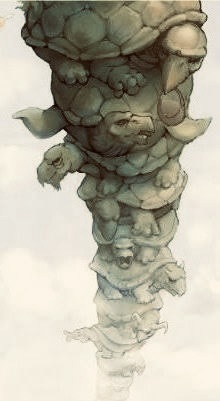
And then there’s the whole issue of infinite regress. Even if we did manage to discover some ultimate law that ties everything together, wouldn’t that just raise more questions? Why does that law exist? Where did it come from? What’s behind it? It’s like we’re always pulling back the curtain only to find another curtain. In a way, this endless chain of questions points toward the necessity of something outside the system—a first cause that doesn’t need explaining. In Christian theology, that’s God: the uncaused cause, the Alpha and Omega. Philosophers like Thomas Aquinas talked about this in terms of the “unmoved mover”, the idea that there has to be something that started everything but wasn’t itself started by anything else. Without that, you’re stuck in this infinite loop of why.
So, maybe the fact that we can’t grasp a Theory of Everything isn’t a failure on our part. Maybe it’s a signpost. It’s like the universe itself is whispering to us, “There’s more than you can see. There’s more than you can know.” And that resonates deeply with the Christian view that ultimate truth isn’t just a set of equations or physical laws, it’s found in a relationship with the divine, something that transcends the boundaries of human understanding.
I guess, in the end, our limits might not be a flaw in the system. They might be an invitation.



 Curious Christian
Leave a comment