Curious Christian

Reflections on culture, nature, and spirituality from a Christian perspective

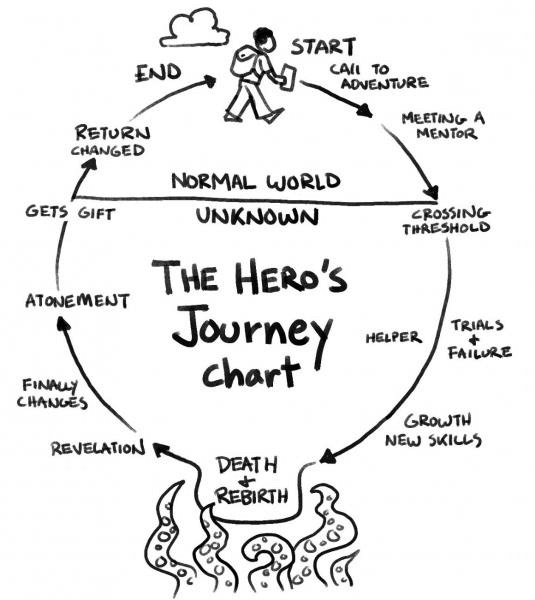
Why is Joseph Campbell important? For those of you not familiar with him, Joseph Campbell was an American mythology professor, writer, and speaker, best known for his book, The Hero with a Thousand Faces. The journey of the hero, what he called the monomyth, figured prominently in Campbell’s comparative studies, and his writings on the hero’s journey have influenced such films as The Matrix and Star Wars. He has also, as a populariser of Carl Jung, exerted a noteworthy influence on popular spirituality, particularly with the Pagan and Gnostic revivals.

Heroes were important to Campbell because, to him, they conveyed universal truths about our own journeys of self-discovery and the means through which societies are renewed.

The personal side. My own interest in Joseph Campbell took off a number of years ago through conversations with Pagan friends who were heavily influenced by him. Indeed I was invited to a Joseph Campbell study group one evening. It dove tailed with my previous interests in Jung, the collective consciousness, alternative spirituality, liminal ritual and the films mentioned above. It also presented me with interesting apologetic challenges, for the story of Jesus was very much interpreted by Campbell through a monomythic lens. In essence, for him, all religions are just masks which obscure the transcendent realities behind myth.

Christian considerations. I have found it interesting, therefore, to explore how Campbell’s thinking squares with the thinking of two Christian mythologists that I am sure you are familiar with, C S Lewis and J R R Tolkien. Drew Trotter writes:

C. S. Lewis’s view of myth and its relation to his stories is complex, and would find some agreement with Campbell’s, but fundamentally he disagrees on a number of crucial points … Eventually, Lewis came to believe in a Christianity that held onto both myth and history and incorporated them both into a belief that Christianity is a myth, but more than a myth because it actually tells of real history and a God who, in space and time, became Incarnate, a word so important to him, he almost always capitalises it.

For more on this see my previous post on Inklings on Myth.

As you might imagine, my thinking is more in line with the Inklings, both in terms of having some fundamental disagreements with Campbell, yet still agreeing in many other ways.

But, despite some criticisms, I believe Campbell has some important insights for us on the power of story, on journeys into liminality, and what this means for the study of spirituality and society. He has particularly influenced how I view and craft alternative worship – in that I consider story far more important than style. And, as you may gather from the name of this blog, I very much see incarnational living as a journey of self discovery and social renewal as well.

11 responses to “Joseph Campbell and the Hero’s Journey”

  1. Paul Maurice Martin Avatar

    Campbell did a great job debunking the phrase “just a myth.” Of the different dream theorists I encountered as an undergrad psych major, I found him the most compelling.

    Like

  2. Isaiah Avatar
    Isaiah

    Thanks for posting!
    One thing I noticed in his works is his idea of the redemptive power of myth, despite whether it is true. I have to say I don’t find this to be true.
    If you look at the stories that truly change people, they are true. Though I believe it is rare to truly find such a powerful and true story to change you, I don’t believe that something like “Legend of Zelda” or “The Simpsons” can actually change your life, because you know they aren’t real. Sure they can make you feel good, but because it didn’t happen you’re reaction to it becomes purely aesthetic in nature.

    Like

  3. Matt Stone Avatar

    I believe what Joseph Campbell is getting at is that myths are true, in a fashion. Or rather that myths, like dreams, can point to buried truths. Call them metaphoric truths if you will. To some extent I accept that.
    And I believe we are far more immersed in myth than we would like to think – I have lost count of the number of Christian urban legends I have heard retold and retold by pastors, bible study leaders and others who would seek to inspire fellow Christians. And these myths do have power of a sort, sometimes even a healthy one.
    But, I agree with you, there is nothing like an account of genuine life change to inspire genuine life change.
    When it comes to the New Testament, I think we need to recognize metaphoric truth and historic truth are interwoven to an extend that it is sometimes difficult to distinguish. At one end you have letters like that of James which are very plain speaking, At the other end you have Revelations, where metaphoric truth very much comes to the foreground.
    This is where I find N T Wright very important. In demonstrating that apocalyptic literature is about historical events, described metaphorically, he brings the history question to the foreground. There is a crucial difference between history mythologized and mythology historicized.

    Like

  4. Matt Stone Avatar

    Actually, on myths being a kind of truth, I think this is what Paul was getting at with his comment about Campbell debunking the phrase “just a myth.” Am I right Paul?

    Like

  5. Isaiah Avatar
    Isaiah

    Sometimes myths can actually have a really negative effect, imbedded in our nature as humans.
    Take “Hotel Rwanda”, I know many people who would feel that have actually done something about suffering in Africa by simply watching the film and feeling sympathy to the victims. This is one way I see that myth can, and is, misused and abused. Myths about justice and the such might act more like a scapegoat then an inspiration.
    What do you think?

    Like

  6. Matt Stone Avatar

    Absolutely. I am a bit of a connasseur of urban legends and, in my experience, they often express the deep phobias one community has of another. When hearing ‘friend of a friend’ stories and anonymous “missionary” stories I always ask myself, how does this story function in the life of the community telling it? What is it doing? Is it scapegoating anything? Anyone? You’ll not above I said Christian urban legends “sometimes” have a healthy power. The corrolery of this is that “sometimes” they do not. Not at all. If I read Campbell correctly his focus is on the “power” of myth, not necessarily it’s “rightness”

    Like

  7. Isaiah Avatar
    Isaiah

    From what I have read Campbell puts myth into two categories, the helpful and powerful myth and the impotent and powerless myth (Which he puts the Christian story, particularly the Gospels in). I do have a problem with the idea of a myth transforming people’s lives, since generally myth falls into the category of scapegoat. Maybe it’s what I observe from my culture, but I find that myth, like all art is more expression of a desire, hope or something and not a creator of something like that.

    Like

  8. Peggy Avatar

    Matt,
    It was helpful to link to the Inklings article so that I could see Phil’s comment — because that piece by Tolkien was what I was thinking as I read your post.
    The thing about myth and fantasy and imagination (a very important aspect of sub-creation) as it has to do with God, is that while it does meld the myth and the history, it calls us to balance them.
    The history is important because God IS and did create all and did makes humans in his image and redeem them in and through Christ. There is a true story of history as well as a projected future.
    The myth is important because God is so very OTHER. We cannot fully see or comprehend the reality because we are OTHER, as well. It is only in Christ, as God who became one of his creatures, that we can begin to see and comprehend glimpses of the reality…and then only as we allow the Holy Spirit to slowly transform us into the very image of Christ.
    As Lewis said in his great essay on Tin Soldiers…it’s not that the rumor going round the workshop is that the Tin Soldiers are going to become animated and seem alive. It is that their tin is going to be turned to flesh and they will become REAL.
    And there is so much of Christianity beneath the surface in Tolkien’s Middle Earth writings…such that only those who know them will recognize them–so as not to cause readers to stumble over “belief” as they read, but to be swept away by the rushing river of eucatastrophe that is the singular mark of our Redeeming God.
    I could just spend all my time pondering such…had to stop and join this conversation, Matt!

    Like

  9. Matt Stone Avatar

    “…since generally myth falls into the category of scapegoat…” I would disagree with that. Myth can fall into that territory but there is a lot that doesn’t. There is a lot that is important for identity, for understanding who we are, why we are here, what we are called to do, how should we organize ourselves, that is important in its own right.
    There is one mythological figure which I thing are especially important for us to grapple with in our own context, and that is the figure of the heroic monk. Many within the emerging church have appropriated this archetype as a way of expressing their own identity and their hopes for the church in exile. Much of this is pure romanticism which says more about us than anything about history. We could say the same for the American cowboy and the Aussie battler in terms of our cultural identities. These archetypes and the stories that surround them tell us much about ourselves. Sometimes closer examination tells us things we would rather not admit. Sometimes they speak to us at a level beyond words.
    Identity construction and myth crafting are closely tied together. If identity construction is a core task of emerging movements, as many sociologists assert, then I reckon we need to pay much closer attention to our own emerging myths.

    Like

  10. Isaiah Avatar
    Isaiah

    “Identity construction and myth crafting are closely tied together.”
    I guess what I am commenting about is more of my real-life discussions with people regarding the power of myth.

    Like

  11. Livia Avatar

    Interesting to know.

    Like

Leave a comment